
Synopsis of Session I of the Fall Retreat: To Become All Flame
When Desire Is Purified into Love
A Reflection on the First Evening of Our Retreat

“If you will, you can become all flame.”
— Abba Joseph
We began our retreat with one of the most familiar sayings of the Desert Fathers, and yet perhaps one of the most inexhaustible.
Abba Lot came to Abba Joseph and described what had become the pattern of his spiritual life. He kept his little rule. He fasted according to his strength. He prayed and meditated. He tried to maintain interior peace and to purify his thoughts. Then he asked the elder a question that arises sooner or later in nearly every serious spiritual life:
“What else can I do?”
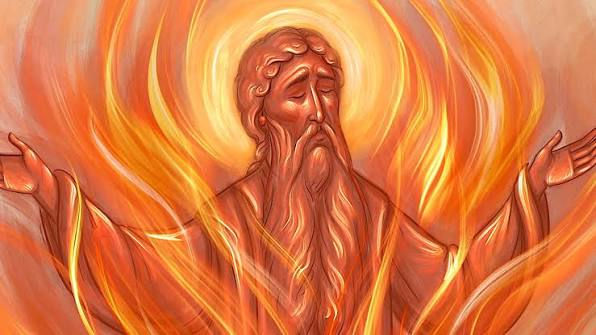
Abba Joseph did not give him another practice. He stood, stretched his hands toward heaven, and his fingers became like ten lamps of fire.
“If you will,” he said, “you can become all flame.”
There is something almost unsettling about the elder’s response. Abba Lot asks what else he should do, and Abba Joseph answers by showing him what a human being can become.
Perhaps much of the spiritual life lies in the distance between those two things.
We begin, necessarily, with practices. We learn to pray. We fast. We read. We struggle with our thoughts. We confess our sins and begin again. We establish rules because without some form, desire remains vague and easily dissipated. The Fathers never despised these things. Their lives were shaped by an extraordinary fidelity to them.
Yet the practices were never the end.
They were ways of standing before the fire.
And the fire was God.
When Improvement Is No Longer Enough
One of the themes that emerged during our conversation was the difference between improvement and transformation.
The distinction is more important than it first appears.
Much of what we call the spiritual life can quietly become a project of improvement. We want to pray better. We want to become less distracted, less anxious, less irritable. We want greater interior peace. We want to overcome particular weaknesses, acquire virtues, understand ourselves more clearly, and become more faithful disciples of Christ.
These are good desires.
But the Gospel finally asks something more of us than improvement.
Christ has not come merely to make us somewhat better versions of ourselves. He has come that we might have life in Him. The language of the Fathers is more daring than the language of self-improvement because their vision of the human person is more daring. They speak of communion, participation, illumination, transfiguration, theosis. They speak of iron placed in the fire until it becomes radiant with a heat and light that are not its own.
The iron remains iron.
But it becomes all fire.
Perhaps this is why transformation frightens us in a way that improvement does not. Improvement allows us to retain a certain measure of control. We can establish goals, measure progress, identify weaknesses, and determine what must be done next.
Transformation eventually requires surrender.
And surrender cannot be measured in quite the same way.
During the evening someone offered a sentence that seemed to gather up much of what we were considering:
We would often prefer improvement to transformation.
I think that is true.
Improvement leaves the self largely intact.
Transformation places the self in the hands of God.
What Draws Us into the Desert?
The conversation then moved toward desire.
We spoke about the Fathers who went into the desert, and one of the questions raised afterward was particularly important: did they go because they had already discovered an overwhelming love for God, or did they sometimes go because they were searching for the love they had not yet fully found?
It is an important distinction because we can romanticize the beginnings of the spiritual life. We imagine that the saints acted from a clarity and purity of intention that we ourselves do not possess. We look at Antony walking into the desert and see a man consumed with love for God. We do not always consider that love itself must be purified, deepened, tested, and stripped of illusion.
Perhaps sometimes we enter the desert because we have found God.
And perhaps sometimes we enter because everything else has ceased to be enough.
There are moments in life when something begins to loosen within us. Things that once satisfied us no longer do. Ambitions lose some of their power. Success does not give what we expected it to give. Even our religious life may begin to feel strangely inadequate. Prayers that once consoled us become dry. Books that once excited us no longer answer the question that has begun to emerge from somewhere deeper.
We may interpret this as failure.
But it may be desire becoming more truthful.
The desert does not always begin with certainty.
Sometimes it begins with hunger.
Something within us begins to understand, long before we can adequately put it into words, that nothing less than God will finally be enough.
When Even Prayer Cannot Satisfy Us
This led to another question from the group: how do we distinguish an authentic desire for God from what the Fathers might call spiritual gluttony?
The distinction can be painfully difficult because spiritual gluttony does not necessarily look worldly. It can look intensely religious.
We can consume spiritual books, teachers, devotions, retreats, methods of prayer, podcasts, theological ideas, and religious experiences. We can move restlessly from one thing to another because something within us remains unsatisfied.
And we may call all of this desire for God.
Sometimes it is.
But desire itself needs purification.
One person spoke of the frustration of moving among different forms of prayer—lectio divina, the Rosary, the Jesus Prayer—and discovering that none of them seems finally to satisfy the hunger for God. The temptation at such a moment is to conclude that we simply have not found the right practice. Perhaps another book, another method, another teacher, another form of prayer will finally give us what we are seeking.
But there may be another possibility.
Perhaps God sometimes allows our spiritual practices to become poor in our hands.
Not because the practices are poor.
Because He is teaching us that they are not Him.
The Jesus Prayer is precious precisely because it leads us toward Jesus. The Scriptures are precious because through them we encounter the living Word. Every authentic form of prayer ultimately points beyond itself toward communion.
Prayer is not a technique for producing the experience of God.
Eventually even our prayer must become poor.
We come before God without knowing how well we are praying, whether we are progressing, whether anything is happening within us at all.
And perhaps the prayer becomes simpler:
Lord Jesus Christ, have mercy on me.
Not because we have ceased desiring God.
Because desire has begun to lose its need to possess Him.
The Exhaustion of Striving
Another question touched upon the exhaustion that can accompany the spiritual life.
Why does desire sometimes exhaust us?
Perhaps because not everything we call desire is yet the desire that comes from God.
There is a form of spiritual desire that remains deeply entangled with our need to become someone. We want to become holy. We want to become prayerful. We want to become healed. We want to overcome the wounds, habits, distractions, and weaknesses that trouble us.
And because we want these things, we begin watching ourselves.
Am I progressing?
Am I praying enough?
Why am I still distracted?
Why do I continue falling into the same patterns?
Why has God not changed this?
Why do others seem to possess a peace that I do not?
The gaze that was meant to rest upon Christ quietly turns back upon the self.
And we become exhausted.
There is another desire, however, that seems to emerge only after much of this has begun to wear itself out.
It is quieter.
It makes fewer demands.
It can coexist with weakness and uncertainty. It can remain even when prayer is dry, when the future is hidden, when the wounds have not disappeared and when life has not become what we once imagined it would be.
It simply says:
I want God.
Not what God can give me.
Not what God can explain to me.
Not the spiritual person I hope God will enable me to become.
God.
Perhaps this is one of the great purifications of desire: we gradually cease trying to possess God and discover that the spiritual life has always been about allowing ourselves to be possessed by Him.
The Grace of Growing Older
Someone spoke during our conversation about the possibility that the spiritual life ripens particularly in old age because we begin to age out of ambition, illusion, judgment, and even our own ideas about what Jesus must give us in order for us to be happy.
There is great wisdom in this.
The younger self, including the spiritually younger self, is often concerned with becoming. We want to know who we are. We want to discover our vocation. We want to accomplish something meaningful. We want to understand what God is doing with our lives.
There is nothing inherently wrong with this.
But life has its own asceticism.
Things are taken from us.
Plans change.
Bodies weaken.
People we love suffer.
Relationships alter.
Doors close.
The future becomes smaller and less controllable.
We discover that some questions will not be answered in the way we once expected.
And gradually the hands open.
What once looked only like diminishment can become another kind of freedom.
Perhaps the spiritual life does not ripen because old age automatically makes us wise. It ripens when loss is allowed to teach us how little we actually need in order to belong completely to God.
The prayer becomes less complicated.
The need to understand diminishes.
The desire to control the future weakens.
The heart begins to discover the strange freedom of receiving the life that is actually being given.
And sometimes what remains is very small.
A name.
A prayer.
A person before us who needs to be loved.
The next act of obedience.
God.
Perhaps that is enough.
Wanting the Father for Himself
Our discussion eventually touched upon the Parable of the Prodigal Son, and another participant offered an observation worth remaining with.
Neither son seems, at least initially, to desire the father simply for himself.
The younger son wants his inheritance and leaves.
The elder son remains at home, but his obedience has also become transactional. He has served faithfully and therefore believes something is owed to him.
Both sons are concerned, in different ways, with what the father can give.
The parable leaves open a deeper question.
Will either son learn to love the father simply because he is the father?
Perhaps this is the question hidden within every spiritual life.
Do we desire God, or do we desire what we hope God will give us?
Would God still be enough if prayer gave no consolation?
If obedience brought no visible reward?
If our vocation unfolded differently than we imagined?
If the future remained hidden?
If certain wounds remained wounds?
If the broken string remained broken?
This is not a question we answer once.
Life answers it slowly within us.
And perhaps God is merciful enough not to demand that we possess such purity of love at the beginning. He receives the mixed desires with which we come to Him. He receives the younger son who wants an inheritance and the elder son who wants recognition. He receives Abba Lot with his little rule and his question about what more he should do.
Then He begins the long work of purification.
We come wanting many things.
Grace slowly teaches us to want the One.
If You Will
And so we return to Abba Joseph.
Abba Lot asks what else he can do.
Joseph does not tell him to abandon his rule, his fasting, his prayer, or his vigilance. He simply reveals the horizon toward which all of them point.
You can become all flame.
The words that precede this are important:
If you will.
There is no violence here.
God does not destroy our freedom in order to transform us. Love waits for consent.
We cannot create the fire.
We cannot transform ourselves.
We cannot force the life of God into the soul through sufficient effort.
But we can remain before Him.
We can stop fleeing the places where He is already waiting.
We can relinquish, little by little, our insistence that the spiritual life unfold according to our expectations.
We can allow our desires to be purified.
We can consent.
And perhaps much of the spiritual life is finally contained in that small movement of consent.
Not the great achievement.
Not the extraordinary experience.
Not the perfect rule.
Consent.
The willingness to remain before God long enough for everything that is not love to be revealed, surrendered, healed, and transformed.
The fire does the rest.
Perhaps this is why the question with which Abba Lot begins eventually becomes inadequate.
What else can I do?
There may come a time when there is nothing more to add.
There is only something left to surrender.
And beneath all the practices, all the seeking, all the questions and all the long years of trying to find our way toward God, another question quietly emerges:
Will I allow myself to be loved into flame?
That may be the beginning of the desert.
And perhaps it is also its end.

Comments