
Reflection One - Fall Retreat "The Spark"
Reflection One: The Spark

“I Have Come to Cast Fire upon the Earth”
“I came to cast fire upon the earth; and would that it were already kindled!”
— Luke 12:49
There are moments in the spiritual life when a person becomes aware of a desire that he cannot entirely explain.
Nothing outward may have changed. He may have prayed for years, received the sacraments faithfully, struggled against familiar sins, and tried sincerely to live according to the Gospel. Yet somewhere beneath all of this another longing begins to emerge.
It may first appear as dissatisfaction.
Not dissatisfaction with God, but with everything that has taken His place.
Words no longer seem sufficient. Religious activity no longer satisfies as it once did. Accomplishments lose some of their attraction. Even good and necessary things begin to feel strangely secondary.
Silence begins to attract us.
Prayer becomes less a matter of saying things and more a desire simply to remain before God.
The Name of Jesus acquires a sweetness that cannot be explained by the syllables themselves.
Solitude no longer feels empty.
And somewhere within all of this the heart begins quietly to say:
I want God.
We may imagine that this is the beginning of our search for Him.
St. Isaac the Syrian would tell us otherwise.
It is the discovery that God has already begun searching for us.
The first movement is never ours.
God loved before we loved.
God desired before we desired.
God called before we listened.
What we experience as our hunger for God is already evidence that grace has touched the heart.
The fire does not originate in us.
God strikes the spark.
†
We speak often about our desire for God. Much less frequently do we speak about God’s desire for us.
Yet Scripture is filled with it.
God searches for Adam: “Where are you?”
He calls Abraham.
He speaks to Moses from the burning bush.
He pursues Israel through the prophets with the language of a wounded lover.
And finally He comes Himself.
The Word becomes flesh.
Christ does not stand at a distance waiting for humanity to find its way back to Him. He enters our condition. He eats with sinners. He touches lepers. He weeps beside the grave of Lazarus. He receives betrayal, abandonment, nails, and death.
On the Cross the desire of God for man is revealed without reserve.
This is not a reluctant God finally persuaded to love us.
This is Love pursuing His creature even into death.
St. Isaac understood this with extraordinary clarity. Creation itself flows from divine love. Providence is love. God’s dealings with humanity are ordered toward healing, restoration, and communion.
We exist because God desired that we exist.
And we are called into communion because Love desires union with the beloved.
The Christian life therefore begins not with obligation but with being desired.
Before asking what we must do for God, we must stand in wonder before what God has done—and continues to do—for us.
Christianity is not fundamentally the story of man’s search for God.
It is the story of God’s relentless search for man.
†
This makes Christ’s words startling:
“I came to cast fire upon the earth; and would that it were already kindled!”
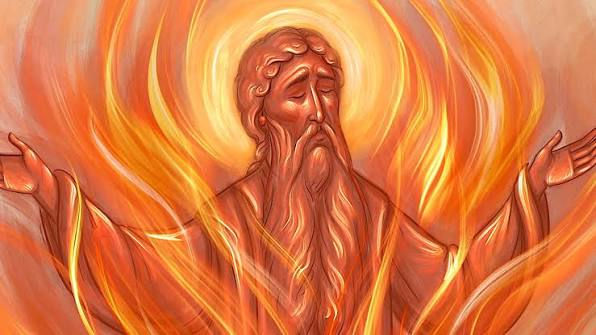
Christ desires something to burn.
The Fathers saw in this fire the Holy Spirit, divine love, purification, illumination, the burning away of sin, the transformation of the human person.
Pentecost makes the image visible.
The Spirit descends as tongues of fire.
And those upon whom the fire rests are changed.
Peter, who trembled before a servant girl, publicly proclaims Christ.
The frightened disciples emerge from behind locked doors.
Men who argued about which of them was greatest begin laying down their lives.
The fire of God has entered human flesh.
This is Christianity.
Not merely believing truths about God.
Not merely behaving according to moral principles.
Not merely belonging to an institution founded by Christ.
Christianity is participation in the life of God.
The Eastern Fathers call this theosis: by grace, the human person becomes a participant in what God is by nature.
They loved the image of iron placed in fire.
The iron remains iron.
Yet gradually it begins to glow. It becomes incandescent. It takes on the properties of the fire.
This is what grace desires to accomplish in us.
†
Perhaps one of the tragedies of the spiritual life is not that we desire too much.
It is that we desire too little.
We ask God to solve our problems, protect those we love, strengthen our ministries, remove suffering, give us peace.
None of these prayers is wrong.
But God desires to give us something infinitely greater.
Himself.
And this frightens us because receiving God eventually means surrendering everything that prevents communion with Him.
We would often prefer improvement to transformation.
We want Christ to make us somewhat more patient, peaceful, disciplined, virtuous.
Christ wants resurrection.
We want renovation.
God wants a new creation.
We want a better religious life.
God wants the whole heart.
This is where the Desert Fathers become unsettling.
When Antony heard Christ say, “If you would be perfect, go, sell what you possess … and come, follow me,” he went.
Not because every Christian must imitate Antony’s external action, but because Antony heard within the Gospel a total claim.
Christ wanted everything.
And Antony discovered that somewhere within himself he wanted to give everything.
That desire was the spark.
†
But here we must be careful.
There is a counterfeit desire that can masquerade as zeal.
We can desire holiness because we want to become extraordinary. We can desire mystical experiences, spiritual knowledge, recognition. We can even desire the desert because it allows us to imagine ourselves as someone different from who we actually are.
The Fathers are merciless toward such fantasies.
True desire makes a person simpler.
Humility deepens.
Judgment diminishes.
The need to be noticed weakens.
Compassion grows.
Prayer becomes quieter.
Repentance becomes more natural.
Holiness is not becoming impressive.
It is becoming transparent.
The saint becomes so transparent that Christ can be seen through him.
Our own fire produces intensity, ambition, and eventually exhaustion.
Divine fire produces something different.
It produces love.
†
Sometimes this desire becomes unmistakable only later in life.
We tend to imagine vocation as something belonging to youth:
What will you become?
What will you accomplish?
Where will you go?
But Scripture is less constrained by age.
Abraham is called into an unknown land when the great movements of his life should seemingly have been behind him.
Moses encounters the burning bush after decades in Midian.
Perhaps there are desires God allows to mature slowly.
A person may need decades before ambition loses its attraction.
Decades before he discovers the limits of his own strength.
Decades before failure teaches compassion.
Decades before mortality ceases being an abstraction.
And then something extraordinarily simple emerges.
Not:
I want to accomplish something great.
But:
I want God.
We should be careful before dismissing such a desire.
It may contain exhaustion or disappointment. It certainly may need purification.
But it may also be grace.
The question is not simply, How strong is this desire?
The question is:
Where did this fire come from?
†
This is why discernment, obedience, and patience remain essential.
But discernment must never become domestication.
The Church does not manufacture charisms.
She receives them.
She tests them.
She purifies them.
She gives them form.
But the Spirit blows where He wills.
The earliest monks remind us of this.
They did not begin with an institution called “monasticism” and decide to join it.
Something happened first.
A hunger.
A word of Scripture.
A wound of love.
A desire for prayer.
A longing for undividedness.
A sense that Christ was asking for everything.
The fire preceded the form.
Only afterward came structures intended to protect and transmit the life that had appeared.
The trellis exists for the vine.
The lamp exists for the flame.
The monastery exists for communion with God.
The rule exists to make the heart free.
Obedience exists to liberate us from self-will so that we may hear God.
Everything exists for communion.
†
Yet perhaps this still sounds extraordinary.
Most of us will not become Antony.
Few will live in deserts.
Most will not become hermits.
That does not matter.
The fire usually begins very small.
Perhaps it is the desire to remain five minutes longer in silence.
The impulse to forgive.
The realization that we no longer need to win an argument.
Compassion appearing where resentment once lived.
The Name of Jesus quietly returning to the heart during the night.
Tears we cannot explain.
Gratitude.
The desire to pray when no one knows we are praying.
Or the strange realization that we want nothing from God except God.
Do not despise this small flame.
Do not immediately analyze it.
Do not turn it into a project.
Protect it.
Feed it with prayer.
Shelter it with silence.
Purify it through repentance.
Test it through obedience.
Let it deepen through patience.
And above all, wonder at it.
Because perhaps the most astonishing realization is this:
The desire within you for God is already evidence of God’s desire for you.
You did not light the fire.
You discovered it burning.
Christ still stands before the human heart saying:
“I came to cast fire upon the earth; and would that it were already kindled!”
And He means us.
Not only Antony.
Not only Isaac.
Not only the saints.
Us.
The exhausted.
The distracted.
The wounded.
The aging.
The uncertain.
Those who have failed.
Those who have spent years around holy things and suddenly discover that they are still hungry for holiness itself.
Those who, after everything, find one prayer rising from somewhere deeper than words:
I want You.
That is enough for the beginning.
The spark has already been struck.
Our task is not to manufacture the fire.
It is to stop smothering it.
And perhaps, if we allow God to do what He desires within us, the little flame we barely perceive today will one day reveal the astonishing truth Abba Joseph showed Abba Lot:
“If you will, you can become all flame.”
Comments