_edited.jpg)
The Lie We Hide Behind
To say “I love God” while refusing love is to stand outside the very life we claim to seek.
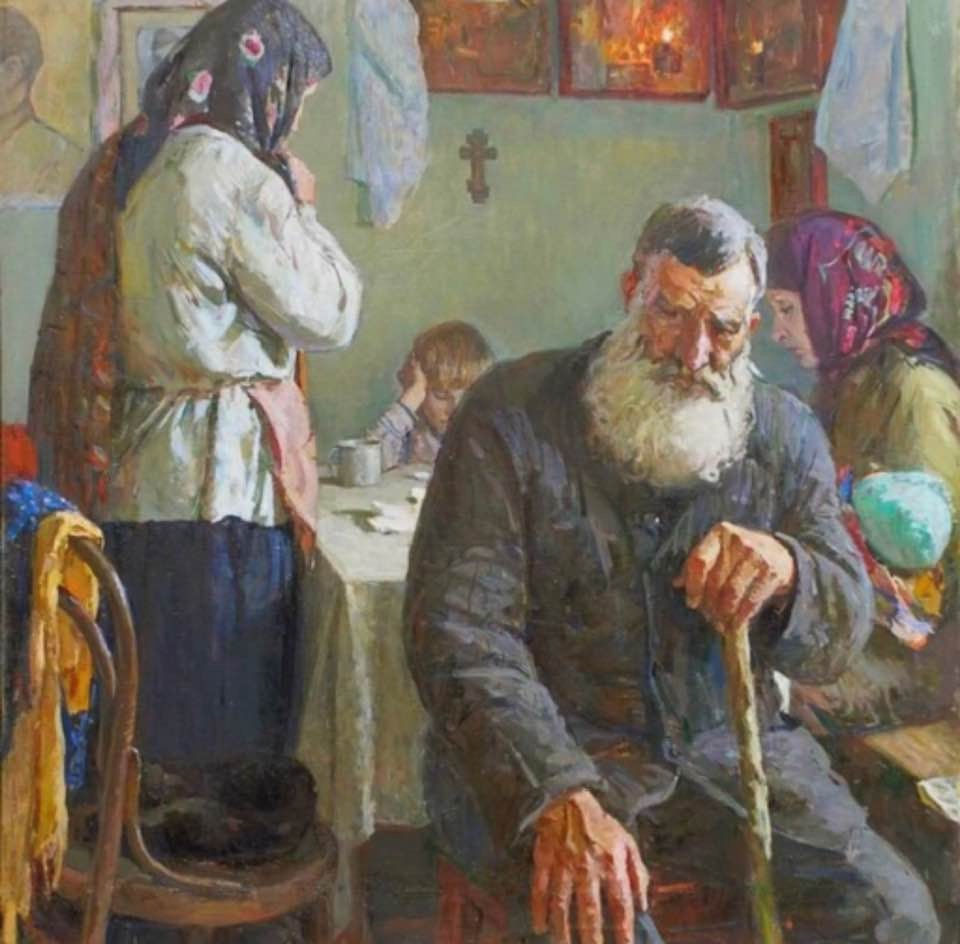
“Acquire the Spirit of peace, and thousands around you will be saved.”
— St. Seraphim of Sarov
St. John does not write here like a sentimental mystic. He writes like a desert father with a knife.
“God is love.”
That is not poetry meant to soothe us.
It is judgment.
Because if God is love, then every refusal to love is not a minor defect in personality. It is resistance to God Himself.
We often imagine holiness as prayer, fasting, silence, theology, liturgy, right doctrine, spiritual discipline, tears before icons, or long hours in solitude. The fathers would not dismiss these things. Neither would the modern elders. But they would ask one fierce question:
Has any of it made you more capable of love?
If not, much of what we call spirituality may only be a refined religious self.
St. John says something brutal:
“Anyone who says, ‘I love God,’ and hates his brother, is a liar.”
Not weak.
Not immature.
Not struggling.
A liar.
That is hard because hatred rarely appears first as obvious hatred.
Often it wears religious clothing.
Hatred can look like contempt.
Like coldness.
Like subtle superiority.
Like enjoying another’s humiliation.
Like inward judgment.
Like withholding tenderness.
Like needing to remain offended.
Like preserving a wound because it justifies distance.
Like secretly feeling cleaner than another sinner.
The desert fathers knew this. A monk could flee to the wilderness and still carry an entire city of hatred in his chest.
You can silence the mouth and still have violence in the heart.
You can leave the world and still be full of accusation.
You can pray the Jesus Prayer while inwardly condemning everyone around you.
Then prayer itself becomes distorted.
It no longer opens into communion.
It becomes self-protection.
St. John tears through illusion:
“Whoever does not love the brother he can see cannot love God whom he has not seen.”
This is devastating.
Because many of us prefer the invisible God.
He does not interrupt us.
He does not offend us.
He does not misunderstand us.
He does not mirror our impatience.
He does not expose our inability to bear weakness.
But the brother does.
The difficult family member.
The awkward visitor.
The person who disappoints us.
The one who speaks poorly.
The one who moves slowly.
The one who wounds us.
The one whose frailty confronts our impatience.
The one whose brokenness touches our own hidden hardness.
There, love is tested.
Not in mystical language.
In irritation.
In hidden resentment.
In how we respond when love costs us comfort.
The elders often said that salvation is learned in bearing one another.
Not because people are easy.
But because love crucifies self-will.
Then St. John reaches deeper:
“Perfect love casts out fear.”
Fear is often more hidden than hatred.
We fear rejection.
We fear humiliation.
We fear being unseen.
We fear losing control.
We fear being hurt again.
We fear not being enough.
We fear punishment.
We fear God.
So we build guarded selves.
The religious ego can do this brilliantly.
It can become disciplined, orthodox, thoughtful, articulate, ascetical, even admired, while still deeply defended.
But love dismantles defense.
Love exposes where we still protect ourselves more than we surrender ourselves.
This does not mean becoming naïve.
It does not mean enabling abuse.
It does not mean pretending wounds are not real.
It means that the final movement of the Christian life is not self-construction.
It is communion.
And St. John gives the deepest humiliation of all:
“We love because he loved us first.”
You did not begin this.
Love is not your achievement.
Not moral excellence.
Not spiritual superiority.
Not emotional maturity.
Everything begins with being loved first.
The fathers knew this deeply.
Only the one who has allowed himself to be broken open before God can begin to love without constant calculation.
Only the one who has stood in poverty before Christ can stop demanding repayment from others.
Only the one who has faced his own darkness can become gentle.
This is why the saints often became softer, not harder.
Stronger, but tender.
Clear, but merciful.
Fierce, but incapable of contempt.
So perhaps the most frightening spiritual question is not:
Do I pray?
Do I fast?
Do I believe correctly?
Do I defend truth?
But this:
Has my life in Christ made me less afraid to love?
Because if God is love, then holiness is not proven first by intensity.
It is proven by whether Christ has made the heart capable of communion.
And if we cannot yet love well, then we begin where all true prayer begins:
Lord, show me where hatred still hides under my piety.
Lord, break the fear that keeps my heart defended.
Lord, teach me to love the brother I can see.
So that I may not lie when I say I love the God I cannot see.


We tend to psychologize everything. I mean everything.
If you have a problem, you look for validation; you look for an understanding ear to respond “I know your pain.” We ruminate over our problems. Why this? Why that? Why me?
It makes us feel complex. It makes our problem complex. And complex problems aren't easy to solve. So we’re stuck in the problem.
….
When I was a kid, living amidst the dysfunction of all kinds, I would get nervous and say to my mother, “Mom, I’m scared.”
Her reply?
“Well don’t be.”
Sounds harsh. Even cruel. Uncompassionate. Not motherly.
But actually it was the best advice she ever gave me.
….
Jesus did the same. He doesn’t psychologize.
…“I…