
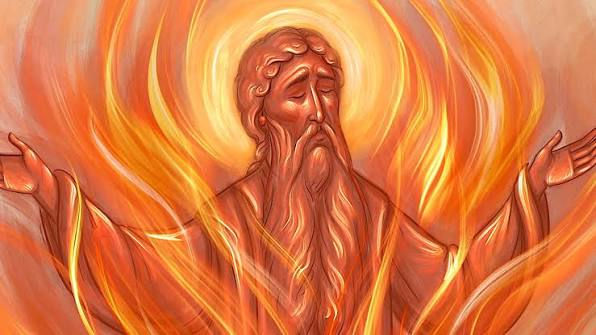
When Desire Must Enter the Fire
The heart does not become pure by wanting God intensely, but by allowing God to purify what it means to want Him.

“There is a desire that seeks God, and there is a desire that seeks to possess even God. Only the fire reveals the difference.”
There comes a moment in the spiritual life when desire itself must be judged.
Not extinguished.
Not distrusted.
But brought into the light.
We begin perhaps because something has awakened in us. The heart discovers that the world cannot satisfy what it has stirred. Prayer acquires a strange sweetness. Silence ceases to be empty. The words of the saints begin to sound less like teachings from another age and more like descriptions of a country we somehow remember.
We become hungry.
And this hunger is a grace.
But the Fathers were far too sober to confuse hunger with holiness.
They knew that we can desire God and still remain deeply attached to ourselves. We can love prayer because of what prayer gives us. We can love solitude because it protects us from contradiction. We can love asceticism because it gives shape to an identity. We can love the Fathers because their words confirm the world we have constructed within ourselves. We can even love repentance because there is a subtle pleasure in thinking of ourselves as repentant.
The ego is capable of entering the sanctuary.
It will kneel.
It will fast.
It will speak beautifully about surrender.
It will even consent to suffering, provided that somewhere within the suffering it is permitted to remain the protagonist.
This is why desire must eventually enter the fire.
The fire of God does not merely intensify what is already within us. It distinguishes.
It separates longing from possession, zeal from self-will, faithfulness from stubbornness, solitude from escape, obedience from fear, sacrifice from the secret desire to be seen as one who sacrifices.
And perhaps most painfully, it separates our desire for God from our desire for the life we imagined we would have with God.
This is where wonder becomes indispensable.
Wonder does not grasp.
It stands before what it cannot control.
The child wonders because the world has not yet become something to be managed. The saint wonders because, after long purification, the world has ceased to be something to be managed.
Between the two lies much of the spiritual life.
We spend years arranging things.
Our vocation.
Our prayer.
Our reputation.
Our usefulness.
Our failures.
Our wounds.
Even our understanding of holiness.
Then God begins quietly removing the arrangements.
What we called progress becomes difficult to measure. What once gave consolation becomes dry. Doors close. Roles disappear. Explanations cease to satisfy. We discover that much of what we thought was faith had been supported by circumstances we assumed would remain.
And there, perhaps, the true work begins.
The question is no longer:
How much do I desire God?
The question becomes:
What am I willing to let God take from my desire so that only He remains?
The Desert Fathers understood this severity.
They did not trust fervor simply because it was fervent. They tested thoughts. They distrusted extraordinary impulses. They fled praise. They feared the subtle intoxication of believing oneself advanced. The elder could sometimes recognize more holiness in the brother who quietly washed a bowl than in the ascetic who had not eaten for days.
Not because fasting was unimportant.
Because love was the measure.
And love is merciless toward illusion.
The modern elders speak with the same sobriety. They continually return us from spiritual imagination to the person before us, the obedience given today, the humiliation we did not choose, the weakness we would rather overcome, the prayer that seems to accomplish nothing.
We would like fire to mean intensity.
Often it means consent.
Consent to remain where we would rather leave.
Consent to leave what we would rather keep.
Consent to be misunderstood without constructing an interior courtroom in which we are always vindicated.
Consent to discover that our great spiritual struggle today may be simply not answering sharply, not indulging a judgment, not protecting our importance, not demanding that another understand us.
These things appear small only because our love is small.
The Fathers knew otherwise.
A single movement of contempt can reveal more about the heart than an entire night of prayer.
A single hidden act of mercy may contain more of the Kingdom than years of religious accomplishment.
The fire is therefore not given to make us impressive.
It makes us simple.
And simplicity is costly because everything false must eventually become unnecessary.
The identities by which we defended ourselves.
The explanations by which we justified ourselves.
The accomplishments by which we measured ourselves.
Even the spiritual language by which we tried to explain the mystery of what God was doing.
One by one they become strangely weightless.
Then something beautiful happens.
Desire remains, but it becomes quieter.
Wonder remains, but it no longer needs extraordinary things.
Prayer remains, but it begins to resemble breathing.
Love remains, but increasingly without calculation.
And the person before us becomes more important than the spiritual life we imagined ourselves living.
Perhaps this is what it means to become fire.
Not to burn more brightly in the eyes of others.
Not to possess unusual fervor.
Not to feel continually aflame.
But to allow everything within us that cannot love to be consumed.
The wood does not become fire by admiring the flame.
It becomes fire by surrendering to it.
And perhaps the final poverty of the spiritual life is this:
we cannot even make ourselves surrender.
We can only remain before God with empty hands and ask Him not to spare what must be burned away.
Not our humanity.
Not our tenderness.
Not our particularity.
But everything within them that refuses love.
Then desire discovers what it had been seeking from the beginning.
Not an experience.
Not an identity.
Not even a destiny we can name.
God Himself.
And when the heart finally begins to understand this, it may have very little left to say.
It simply remains near the fire.
And allows itself to burn.
*******
O Lord Jesus Christ, Son of God,
purify the desire of my heart.
Burn away all that is not love.
Teach me to seek neither consolation nor certainty,
but You alone.
Grant me repentance, humility, and an undivided heart,
that Your holy will may be accomplished in me.
Lord Jesus Christ, Son of God, have mercy on me. Amen.


Comments