
Synopsis of Session II of the Fall Retreat: To Become All Flame
The Fire in the Life We Have
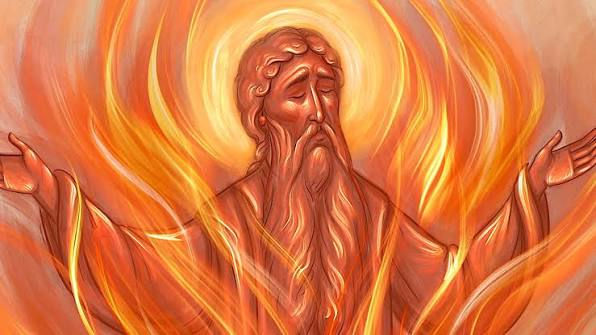
We do not become flame by escaping the conditions of our life, but by allowing everything within them to become an offering to God.
“If you will, you can become all flame.”
— Abba Joseph
Abba Lot came to Abba Joseph with the question that quietly haunts every serious spiritual life.
He had a rule. He fasted a little. He prayed. He meditated. He guarded his thoughts and sought interior peace. None of these things were small. Yet something within him knew that the Christian life could not finally be reduced to the faithful performance of spiritual practices.
“What else can I do?”
Abba Joseph did not give him another practice.
He stood, stretched his hands toward heaven, and his fingers became like ten lamps of fire.
“If you will,” he said, “you can become all flame.”
This second session of To Become All Flame remained within the mystery contained in those words. The Fathers do not invite us merely to become more religious. They do not offer us techniques by which we construct a better version of ourselves. They place before us something far more unsettling and beautiful: the possibility that the whole human person might become transparent to grace.
The question is no longer simply, What should I do?
The deeper question is:
What am I willing to become?
The Prayer Must Descend
One of the questions raised during the evening concerned the distinction between the Jesus Prayer and noetic prayer.
The question itself touches something essential. We can easily begin looking for a technique—breathing in a certain manner, repeating particular words, acquiring a particular interior state. Yet the tradition is always drawing us deeper.
“Lord Jesus Christ, Son of God, have mercy on me.”
At first we say the prayer.
Then, by grace, the prayer begins to gather us.
The mind that has been scattered among a thousand things is drawn toward the heart. Prayer ceases to be merely one activity among others and gradually becomes the orientation of the person toward God.
This is why technique can never be the heart of the matter. Breath may be used with discretion. A rule may help us. Repetition may gather the attention. But no method can produce communion with God.
We are not trying to master prayer.
We are allowing prayer to master us.
The movement is from the lips toward the heart, from multiplicity toward simplicity, from our effort toward a growing receptivity to grace.
Eventually the deepest prayer may contain very few words.
Sometimes only the Name remains.
Sometimes only presence.
The Cell We Want to Escape
Another question brought the teaching into an especially difficult place.
What happens when the very person with whom we live awakens our passions? What happens when home does not feel like a place of stillness but the place where irritation, anger, resentment, judgment, and every hidden wound continually rise to the surface?
Our instinct is often to imagine that spiritual life would flourish if only the circumstances were different.
If I had more silence.
If this person understood me.
If I lived among people who loved God as I do.
If I could finally get away from the thing that continually disturbs my peace.
But the desert fathers understood the cell differently.
The cell reveals us.
The person who troubles us may expose something we would never discover in solitude. The irritation is real. The wound may be real. We do not romanticize destructive behavior or call evil good. Yet neither do we imagine that holiness consists in arranging circumstances so carefully that nothing within us is ever disturbed.
Sometimes the disturbance reveals precisely what still requires healing.
And so the place we wanted to flee becomes a place of repentance.
One participant expressed this with remarkable clarity: temptations themselves had begun to drive her toward Christ. What initially seemed only an obstacle was awakening repentance, deeper prayer, and eventually even prayer for those who wounded her.
This is already the beginning of fire.
For grace has begun to accomplish something extraordinary.
The prayer changes.
We cease merely asking God to remove the other person.
We begin asking Him to have mercy upon us both.
The heart enlarges.
Even the Desire for Holiness Must Be Purified
Another participant confessed something the Fathers knew intimately.
He imagined himself becoming a man of deeper prayer and greater devotion to the Church—and almost immediately imagined other people admiring him for it.
There is the human heart.
Even holiness can become material for vanity.
We can desire humility because we would like to be known as humble. We can love silence while secretly hoping someone notices how contemplative we are. We can acquire books, prayers, fasting rules, icons, theological knowledge, even an entire ascetical identity while the ego quietly feeds upon all of it.
The Fathers are merciless about this because they are merciful toward us.
They want us free.
We need not be horrified when vanity reveals itself. Nor should we despair because mixed motives accompany our desire for God.
We notice them.
We confess them.
We laugh, perhaps, at the absurdity of the ego.
And then we return to Christ.
Again.
Again.
Again.
The discovery of vanity can itself become humility when we cease being surprised that we need mercy.
The fire burns even this.
Especially this.
The Need to Be Useful
At another point a simple phrase appeared in the conversation:
being useful.
Few things are more deeply embedded in us.
We measure our lives by usefulness. We ask what we have accomplished, what we have produced, whom we have helped, whether our gifts are being employed adequately. Even service can become another means of securing an identity.
But there are seasons in which God allows usefulness itself to be taken from us.
Illness.
Age.
Caregiving.
Hiddenness.
Failure.
A vocation that changes form.
A life narrowed by circumstances we did not choose.
Then another question emerges:
If I cannot do what I once did, am I still offering God my life?
The desert answers yes.
Our value before God does not arise from our productivity.
There is an offering deeper than usefulness.
Presence.
Consent.
Love.
A human being quietly remaining before God may appear to accomplish almost nothing and yet become a place where the world is held before Him in prayer.
The flame does not need to be impressive.
It only needs something willing to burn.
But I Have Work, Children, and a House
Then came perhaps the most important practical question of the evening:
How can someone remain in prayer and in the presence of God while working, caring for children, and attending to the responsibilities of a household? What sort of prayer rule makes such a life possible?
This question prevents the desert from becoming romantic.
Most Christians do not live in caves.
They make breakfast.
They drive children somewhere.
They answer emails.
They wash clothes.
They care for aging parents.
They go to work tired.
They prepare meals.
They are interrupted.
And sometimes they fall asleep before finishing their prayers.
If becoming all flame required freedom from these things, then the Gospel would belong only to those capable of withdrawing from ordinary human life.
But Christ entered precisely this life.
The question, therefore, is not how to construct a monastic existence inside circumstances that will not permit one.
The question is how the life we have been given can become prayer.
A prayer rule should gather us toward God, not become another measure by which we condemn ourselves.
Better five minutes offered with the whole heart than an elaborate rule performed anxiously while resenting everyone who interrupts it.
Begin simply.
Return often.
Invoke the Name.
Let brief moments become doors.
“Lord Jesus Christ, have mercy.”
Before beginning work.
While driving.
While washing dishes.
When anger rises.
When the child cries.
When fear comes.
When someone wounds us.
When we awaken in the night.
The prayer slowly begins to accompany life rather than compete with it.
And something changes.
We discover that the monastery we imagined elsewhere has been hidden inside obedience to the present moment.
From One Degree of Glory to Another
Near the conclusion of the conversation, someone placed in the chat the words of St. Paul from the Second Letter to the Corinthians:
“We all…are being transformed…from one degree of glory to another.”
This is the mystery.
Transformation is usually imperceptible to the person undergoing it.
Fire works quietly.
We pray and still become distracted.
We repent and fall again.
We seek silence and discover noise within ourselves.
We attempt to love and encounter the terrible narrowness of the heart.
Yet something is happening.
The person who once responded immediately in anger hesitates for an instant.
The one who prayed only for deliverance begins praying for the person who caused the suffering.
The person who needed to be admired begins to see vanity without obeying it.
The person who believed prayer required ideal circumstances begins whispering the Name while folding laundry.
The person who measured life by usefulness discovers the immeasurable dignity of simply remaining before God.
These things seem very small.
So does a spark.
Become What the Fire Makes of You
Perhaps this is why Abba Joseph’s answer remains so powerful.
Abba Lot wanted to know what else he should do.
Joseph showed him what a human being could become.
This distinction contains almost the whole spiritual life.
We begin with practices because we must.
We pray.
We fast.
We repent.
We guard the heart.
We struggle with thoughts.
We return to the cell.
But none of these is an end in itself.
They place the human person before God.
And there we remain.
Not manufacturing holiness.
Not constructing an identity.
Not becoming impressive.
Simply remaining before the Fire.
The circumstances differ for each of us.
For one person the cell is literal.
For another it is a marriage.
For another, children.
For another, illness.
For another, caregiving.
For another, loneliness.
For another, work that seems terribly ordinary.
For another, the humiliating discovery that even the desire to become holy has been mixed with vanity.
No matter.
Bring that.
Bring precisely that.
Do not wait for another life in which to become holy.
Do not wait for silence before beginning to pray.
Do not wait until the passions disappear before turning toward Christ.
Do not wait until your motives are pure before offering Him your desire.
Do not wait until you become someone else.
The fire descends upon what is offered.
And perhaps this is the great tenderness hidden within Abba Joseph’s words.
He does not say:
If you are strong enough.
He does not say:
If you understand enough.
He does not say:
If you withdraw far enough from the world.
He says:
If you will.
There is the freedom God preserves within us.
There is the small opening through which grace enters.
There is the beginning of the entire spiritual life.
A little consent.
A heart turned toward Christ.
A Name whispered in the midst of everything.
And then the long, hidden work of grace.
Until prayer is no longer something we do.
Until love is no longer something we occasionally offer.
Until the life we once tried so anxiously to perfect becomes an offering.
Until there is less and less of us that we withhold from God.
Until, by grace, the fire has nowhere left to go because everything has been given to it.
If you will, you can become all flame.


Comments