_edited.jpg)
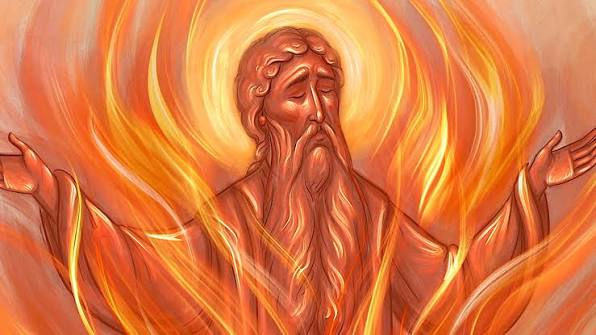
Vessel of Fire
The heart was not made merely to survive, but to become spacious enough for the Spirit of God.

“As much as the soul goes forward and progresses, so much does it thirst for God.”
— St. Isaac the Syrian
There is a dangerous temptation in the spiritual life:
To desire relief more than God.
We ask for peace.
We ask for clarity.
We ask for healing.
We ask for answers.
We ask for some inward quieting of the storm.
Yet the saints often desired something deeper and far more terrible.
They desired the Holy Spirit.
Not consolation alone.
Not religious feeling.
Not spiritual experiences.
Not admiration.
Not holiness as identity.
But the living fire of God Himself.
The desert fathers knew this.
A monk could leave the world, embrace silence, fast, pray through the night, and still remain inwardly full of himself. The outer desert was never the goal. The real desert was the breaking open of the heart until it could receive God.
This is why the fathers fought not merely passions, but narrowness of heart.
A hard heart.
A defended heart.
A self-enclosed heart.
A calculating heart.
A heart organized around survival.
Because the Holy Spirit does not descend into a life built around self-preservation.
He enters where there is poverty.
Where there is surrender.
Where there is hunger.
Where there is room.
St. Seraphim said the true aim of the Christian life is the acquisition of the Holy Spirit. He did not mean possession, as though grace were property. He meant a life so purified, surrendered, and illumined that the Spirit could dwell and radiate through it.
This is what we should tremble to desire.
Not to become “spiritual.”
But to become habitable to God.
Few saints embody this more strangely and beautifully than St. Philip Neri.
Philip, the laughing saint, the desert father in the city.
Before he became known for humor, tenderness, and fierce freedom, he was a man consumed by longing.
He would descend into the Roman catacombs to pray.
Alone.
Hidden.
In silence beneath the city.
There, on the Vigil of Pentecost, while praying in deep desire for God, the Holy Spirit descended upon him with such force that tradition says a globe of fire entered his chest. His heart expanded violently. Two ribs were said to arch outward permanently.
Whether one speaks medically, mystically, or symbolically, the spiritual meaning remains profound:
The Holy Spirit does not merely comfort the heart. He enlarges it.
Philip became what the Litany calls him:
Vessel of the Holy Spirit.
That title should humble us.
A vessel is empty before it is filled.
This is where many of us resist grace.
We want fullness without emptiness.
Light without surrender.
Love without purification.
Fire without dying.
The modern elders saw this clearly.
St. Silouan the Athonite learned that the Holy Spirit is known through humility and love. Where pride reigns, grace withdraws. Where the heart descends, God draws near.
St. Sophrony of Essex spoke of the enlargement of the human person into hypostatic being, where prayer ceases to be private religious effort and becomes bearing the whole world before God. The Spirit widens the heart beyond self-concern.
St. Paisios the Athonite often showed that grace rests naturally in simplicity, sacrifice, and hidden love.
All of them reveal the same truth:
The Holy Spirit enlarges the heart outward.
Not inward toward obsession with self.
Outward toward communion.
Outward toward compassion.
Outward toward suffering borne without bitterness.
Outward toward prayer that begins to carry others.
Outward toward love that no longer calculates.
This matters deeply in our age.
Many hearts have become small.
Fragmented by distraction.
Guarded by fear.
Exhausted by noise.
Organized around image, defense, and self-construction.
We have learned how to perform religion.
But not always how to burn.
We can have theological precision and little tenderness.
Ascetical language and little surrender.
Orthodoxy of mind and poverty of heart.
The fathers would call this a subtle tragedy.
Because Christianity is not meant to produce well-defended religious selves.
It is meant to produce saints whose hearts have become spacious through grace.
So perhaps the deepest prayer is not:
Lord, make my life easier.
Lord, remove all struggle.
Lord, make me feel spiritual.
But this:
Lord, enlarge my heart.
Break what remains narrow.
Burn what remains false.
Empty what remains crowded with self.
Drive out fear.
Teach me to desire You more than consolation.
Make me a vessel, not merely a spectator of grace.
St. Philip’s ribs bent outward.
Most of ours will not.
But if we truly receive the Spirit, something should still break outward:
Pride.
Self-protection.
Coldness.
Calculation.
Fear.
And from that breaking, love.
For the true sign of the Holy Spirit is not intensity alone.
It is a heart widened enough to bear God, neighbor, suffering, and joy without collapsing inward again.
That is what we should desire.
Not merely survival.
But fire.


Comments