_edited.jpg)
To Enter and Not Return
St. Philip Neri: A Desert Father in the City (Feast - May 26th)

“Let us concentrate ourselves so completely in the divine love, and enter so far into the living fountain of wisdom, through the wounded Side of our Incarnate God, that we may deny ourselves and our self-love, and so be unable to find our way out of that Wound again.”
— St. Philip Neri
There are saints who seem, at first glance, to belong to worlds very different from the Desert Fathers.
Philip Neri appears to be one of them.
He did not dwell in Scetis. He was not clothed in the harsh silence of the Egyptian wilderness. He did not withdraw into caves or barren mountains. He walked the streets of Rome. He laughed easily. He gathered young men around him. He welcomed beggars, nobles, scholars, priests, laborers, and sinners. He lived in the movement and noise of a city.
And yet, the deeper one enters his life, the more one begins to recognize something profoundly desert-like in him.
Philip was, in many ways, a desert father living in the city.
That great maxim of his reveals the very center of his spirituality: to enter so deeply into divine love, through the wounded Side of Christ, that one can no longer easily find the way back out of that Wound.
This is not sentimental language.
It is ascetical.
It is theological.
It is existential.
The Desert Fathers spent their lives learning how to descend beneath appearances. For them, salvation was not external correctness. It was not merely moral seriousness, nor theological precision, nor visible religious effort. It was the purification of the heart. The exposure of the passions. The dismantling of illusion. The slow and often painful transformation of the person in God.
Philip knew this same path.
Not in the Egyptian desert.
But in Rome.
Before he became known as the joyful saint of the city, Philip was a man of fierce hidden prayer. He spent long hours in silence, especially in the catacombs of San Sebastiano, seeking not spiritual experience, but God Himself. There, before the hiddenness of death and eternity, his life was quietly shaped.
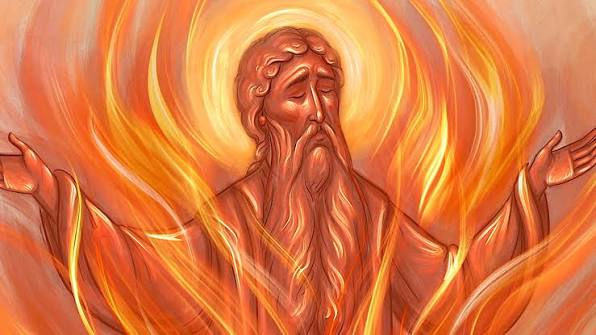
And there the Holy Spirit entered him like fire.
Tradition tells us his heart was enlarged so powerfully that his ribs expanded outward. Whether one lingers on the miracle itself or the deeper spiritual meaning, what remains unmistakable is this:
Philip desired not religion alone.
He desired God.
This is profoundly philokalic.
The Fathers teach us that the heart is not sentimentality. It is the center of the person. The place of desire, memory, struggle, temptation, prayer, and encounter. To enter it truthfully is terrifying because it means leaving behind the false life we build through image, control, usefulness, spiritual vanity, and self-construction.
Philip understood this.
His maxim does not tell us merely to seek comfort in Christ.
It tells us to enter the Wound.
To enter divine love so deeply that self-love loses the way back.
That is severe.
And beautiful.
For how often do we approach Christ while quietly hoping to remain unchanged?
Heal me, but let me remain myself.
Comfort me, but let me preserve control.
Forgive me, but let me continue protecting the image I have built.
Philip says something far deeper:
Enter so far into Christ that self-love no longer easily returns.
This is pure desert wisdom.
Like Abba Arsenius, he fled praise.
Like Abba Moses, he distrusted judgment.
Like Abba Macarius, he concealed holiness.
Like the Fathers, he knew the ego survives very comfortably inside religion.
And so he fought vanity not always through harshness, but often through simplicity, humor, humility, and hiddenness. He resisted becoming impressive. He refused to become spiritually theatrical.
The Desert Fathers often fled into solitude because the city could scatter the heart.
Philip entered the city without allowing the city to enter him.
That may be his greatest asceticism.
He lived among noise while preserving interior silence.
He loved souls without being consumed by activism.
He guided many without constructing identity around spiritual authority.
He remained deeply human without losing hiddenness.
That is why I have long thought of Philip as a desert father of the West.
Not because he copied the externals of Egyptian monasticism.
But because he embodied desert anthropology.
The true desert is first interior.
It is where illusion weakens.
Where ego begins to die.
Where prayer deepens beyond performance.
Where the self no longer seeks to survive through admiration, control, or religious identity.
Where the heart slowly becomes spacious enough for divine love.
This is also why Philip remains a patron of Philokalia Ministries.
At first glance, some may wonder why a Western saint stands so naturally beside St. Isaac the Syrian, the Desert Fathers, Silouan, Sophrony, or Zacharias.
But Philip belongs there.
Because Philokalia Ministries has never been about East against West, nor about spiritual identity as something exotic or borrowed.
It has been about the recovery of the heart.
The return to stillness.
The remembrance of God.
The healing of desire.
The dismantling of illusion.
The slow purification of the human person.
Philip lived this.
He reminds us that the ascetical life is not foreign property. It belongs to the whole Church wherever souls hunger for God.
And perhaps this is why he stands naturally as a quiet patron of City a Desert Press.
What is a city?
Noise.
Movement.
Commerce.
Identity.
Urgency.
Visibility.
Distraction.
And what is a desert?
Silence.
Watchfulness.
Poverty.
Purification.
Truth.
Prayer.
Hiddenness.
Philip held both.
He lived in the city.
Yet inwardly, he became desert.
Or perhaps more truly:
He entered the Wound and remained there.
That is what this ministry has always sought.
That is what these writings have slowly tried to serve.
Not information.
Not production.
Not religious performance.
But the long return inward.
Toward silence.
Toward truth.
Toward the hidden life.
Toward Christ.
And perhaps to enter so deeply into divine love that one no longer easily finds the way back to self-love.
On his feast day, Philip remains for us not only the joyful saint of Rome.
But a fierce and tender father of the hidden life.
A desert father in the city.
A Western witness to the inner desert.
And a reminder that the deepest pilgrimage is always inward—through the Wound, into the living fountain of wisdom, and finally into the Heart of Christ.
St. Philip Neri, pray for us.

Comments