
There Is No Other
When the Heart Ceases to Live as Though Anything Existed Apart from God

“Let all men know from the rising to the setting of the sun that, apart from me, all is nothing. I am the Lord: there is no other.”
— Isaiah 45:6
There are words in Scripture that console us, words that instruct us, and words that seem to leave nothing standing.
This is one of them.
“I am the Lord: there is no other.”
We can hear such words as a declaration about the uniqueness of God. And certainly they are that. The prophet speaks into a world crowded with gods, powers, kingdoms, ambitions, and fears, and announces with devastating simplicity that none of them possesses what belongs to God alone.
But the fathers of the desert would not have allowed us to leave the words safely in the realm of doctrine.
They would have brought them into the cell.
And there the words become dangerous.
Because the idols that must finally fall are not merely the gods worshiped by nations. They are the innumerable things within us to which we quietly attribute an existence they do not possess.
Our plans.
Our reputation.
Our accomplishments.
Our wounds.
Our usefulness.
Our failures.
Our imagined future.
Even the carefully constructed self we have spent a lifetime defending.
“I am the Lord: there is no other.”
The desert exists, in part, so that we may discover whether we actually believe this.
The monk goes into the desert and begins relinquishing the things by which human beings ordinarily establish themselves in the world. Possessions are reduced. Speech is reduced. Movement is reduced. Recognition disappears. The usual mirrors in which the self discovers its importance are slowly taken away.
What remains?
At first, painfully, the self remains.
Perhaps that is one of the great surprises of the ascetical life. We can leave the world and carry the world entirely within us. We can renounce possessions while remaining possessed by ourselves. We can enter silence while continuing an endless conversation with our own thoughts. We can surrender status and secretly construct another identity from our humility, prayer, suffering, or holiness.
The desert therefore must become more severe.
It must reach the place where even the spiritual self can no longer sustain itself.
The fathers called this humility, but humility for them was something far deeper than thinking poorly of oneself. It was the recovery of reality.
God is.
I am because God gives me being.
God lives.
I live because His breath sustains me.
God loves.
I am capable of love because I have first been held within a love I did not create.
Everything is gift.
Nothing is possessed.
Nothing originates in me.
This is why the saints can sometimes speak about themselves with a severity that sounds almost unbearable to modern ears. They are not indulging in self-hatred. They have glimpsed something about existence itself. Before God, the autonomous self they once defended has been revealed as an illusion.
There is no life apart from Him.
There is no goodness apart from Him.
There is no beauty apart from Him.
There is no holiness apart from Him.
There is no other.
And strangely, this discovery does not annihilate the human person.
It frees him.
The modern heart often imagines that freedom requires establishing the self: defining it, protecting it, expressing it, making certain that it is seen and acknowledged. The desert proposes almost the opposite movement.
Freedom begins when the exhausting project of establishing ourselves can finally end.
I do not have to make myself exist.
I already exist because God wills me.
I do not have to justify my life.
I have received it.
I do not have to secure the future.
It has never belonged to me.
I do not have to preserve an image of myself.
There is only the face turned toward God.
Perhaps this is why so many of the elders become simpler as they grow older.
Not simplistic.
Simple.
The multiplicity within them begins to disappear.
The endless negotiations with life become fewer. The arguments quiet. The need to explain oneself diminishes. The future loses some of its tyranny. Even the question of what one is meant to accomplish becomes less urgent.
One thing remains.
God.
The Jesus Prayer carries the heart toward precisely this simplicity.
“Lord Jesus Christ, Son of God, have mercy on me.”
Again.
And again.
And again.
Until prayer ceases to be one activity among many and begins to reveal the truth beneath every activity.
God is.
I am before Him.
Everything else is passing.
The prayer does not make the world insignificant. Quite the opposite. Once things cease pretending to be God, they can finally become themselves.
Bread becomes gift.
Another person’s face becomes mystery.
Work becomes obedience.
Suffering becomes a place where love may remain.
Silence becomes presence.
The ordinary becomes luminous.
Creation no longer has to carry the unbearable weight of being ultimate.
Neither does another person.
Neither does the Church.
Neither does our vocation.
Neither does our past.
Neither does our future.
Neither do we.
There is an immense mercy in this.
Much of our suffering comes from asking finite things to give us what only God can give. We ask another person to secure our identity. We ask a vocation to prove that our life has mattered. We ask institutions to guarantee belonging. We ask accomplishments to protect us from mortality. We ask the future to justify the sacrifices of the past.
And eventually every one of these things fails beneath the weight.
Not necessarily because they are bad.
Because they are not God.
“There is no other.”
The sentence that first sounds severe begins to sound like liberation.
The false gods are relieved of their burden.
And so are we.
This is also the hidden wisdom behind the strange question of the desert:
Why not become all flame?
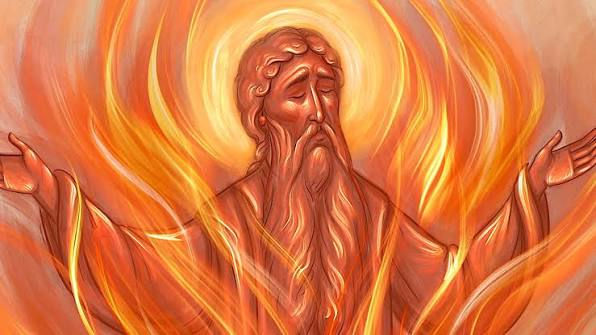
The saying attributed to Abba Joseph is not an invitation to spiritual magnificence. The elder stretches his hands toward heaven, his fingers becoming like lamps of fire, and tells Abba Lot: “If you will, you can become all flame.”
But what burns?
Everything that cannot survive the presence of God.
The illusion of self-sufficiency.
The need to possess.
The demand to control.
The carefully maintained identity.
The secret conviction that our plans must succeed.
The belief that our usefulness determines our worth.
The fear that if everything familiar is taken from us, nothing will remain.
The fire answers:
God will remain.
And perhaps the entire ascetical life is finally consent to that fire.
Not the destruction of the person, but the destruction of everything that prevents the person from becoming transparent to God.
The iron placed in the furnace does not cease to be iron. Yet gradually it takes on the qualities of the fire. It glows with a heat that did not originate in itself. It gives light that it could never produce alone.
So too the human heart.
The saints do not become less human as they disappear into God.
They become incandescently human.
Mercy passes through them.
Compassion passes through them.
Prayer passes through them.
Christ passes through them.
And eventually one encounters less and less resistance.
This is holiness.
Not the triumphant construction of a religious self, but the gradual disappearance of everything that says, “I am my own.”
The elder sitting quietly in his cell.
The mother tending a child in the night.
The person caring for someone who can no longer repay the love given.
The monk repeating the Name while doing some unnoticed task.
The old man whose strength has left him but whose heart has become gentle.
The person whose future has collapsed and who nevertheless whispers:
“Glory to God.”
These may be nearer to the mystery than we imagine.
Because the kingdom does not finally belong to those who have made something impressive of their lives.
It belongs to the poor in spirit.
Those who possess nothing.
Not even themselves.
From the rising of the sun to its setting, creation continues its immense confession.
Mountains stand because He wills them.
Stars burn because He sustains them.
The heart beats because He gives it another moment.
And somewhere in the hidden places of the world, a human being finally stops resisting this truth.
The hands open.
The plans loosen.
The arguments cease.
The Name remains.
Perhaps this is what the desert has been trying to teach us from the beginning.
Not how to become extraordinary.
Not how to become spiritually successful.
Not even how to become holy as though holiness were another possession.
Only how to become combustible.
To stand before God with so little left to defend that His fire can pass through us without obstruction.
Until prayer becomes flame.
Until mercy becomes flame.
Until love becomes flame.
Until even the one who burns no longer thinks very much about the burning.
There is only God.
And the heart, having surrendered everything it once mistook for life, discovers that it has not fallen into nothingness.
It has fallen into Him.
“I am the Lord: there is no other.”
And at last this is no longer frightening.
It is enough.
More than enough.
It is everything.


Comments