_edited.jpg)
The Hour Between Departure and Fire
Remaining in the World After the Ascension

“Keep thy mind in hell and despair not.”
— Saint Silouan the Athonite
There is something painful about this Sunday between the Ascension and Pentecost.
Christ has ascended.
The disciples are left standing beneath an empty sky.
Pentecost has not yet come.
The Church stands in an in-between place.
And if we are honest, most of our spiritual life is lived precisely there.
Not in the moment of illumination.
Not in the moment of resurrection joy.
Not yet in the fire of Pentecost.
But in the ache of absence.
Christ says today, “I am no longer in the world, but they are in the world.”
That line should wound us a little.
Because the Christian life is not escape from the world. It is remaining in the world after we have seen something of Christ. Remaining after the consolations fade. Remaining after certainty collapses. Remaining after prayer becomes dry and difficult and silent.
The desert fathers understood this.
A young monk would come to the desert expecting visions and peace and spiritual power. Instead, he discovered his own heart. He discovered rage, lust, vanity, fear, fantasies of greatness, resentment, despair, and the terrible need to be someone.
And this is where many people flee.
Not from God.
But from themselves.
Modern people speak constantly about authenticity, but most of us cannot bear even five minutes of silence because silence exposes us. The phone lights up because the heart is dark. Noise has become anesthesia. Activity has become a way of avoiding God.
And religion itself can become part of the avoidance.
One of the great temptations after the Ascension is to replace the living Christ with religious activity. To keep ourselves busy because we cannot endure the poverty of waiting.
But notice what the apostles did between Ascension and Pentecost.
They waited.
That sounds simple until you actually try to do it.
To wait without controlling.
To pray without immediate consolation.
To remain faithful without emotional reward.
To stand before God without constructing a dramatic spiritual identity.
This is exceedingly hard.
The modern world forms people who must constantly perform themselves. Even suffering becomes performance. Even spirituality becomes performance. We curate identities instead of entering repentance.
But Christ today speaks of eternal life in a shocking way:
“This is eternal life, that they should know you.”
Not know about God.
Know Him.
And according to the Fathers, that knowledge is born precisely in purification of heart. Not information. Not religious excitement. Not ideological certainty.
Purity of heart.
Which means what?
It means becoming simple enough to stand before God without disguise.
That is terrifying.
Most of us would rather be impressive than pure.
So Christ allows the ascension.
He withdraws the felt nearness.
He permits the emptiness.
Why?
Because He is preparing the apostles to receive the Holy Spirit not as emotional intoxication, but as fire capable of inhabiting truth.
The elders say that God often hides Himself precisely because we still seek Him for ourselves rather than for Himself.
And this is where the Gospel becomes fierce.
Jesus says, “I glorified you on earth by accomplishing the work you gave me to do.”
The glory of Christ is not worldly success.
It is obedience unto death.
The modern world glorifies visibility, influence, expansion, branding, recognition. Christ glorifies the Father by disappearing into obedience.
This is why the saints become hidden.
Not because they hate the world.
But because they no longer need to feed upon it.
The closer a person comes to God, the less theatrical he becomes.
There is a terrible amount of theater in religion now. Endless opinions. Endless outrage. Endless self-display. But very little silence. Very little compunction. Very little trembling before God.
The desert fathers would say we have become strangers to tears.
Not emotionalism.
Tears born from truth.
Tears born when a man finally sees the distance between the Gospel and the self he has constructed.
And yet this Gospel is not despair.
Christ is praying.
That is the astonishing thing.
The disciples are weak. Confused. Fearful. Soon they will scatter.
And Christ prays for them.
Before Pentecost comes the revelation that salvation does not rest upon our strength but upon His intercession.
This is crucial because many people secretly believe holiness means becoming spiritually impressive.
No.
Holiness begins when a man finally stops pretending.
When he ceases trying to appear holy and instead begins crying out from the heart.
“Lord, have mercy on me.”
The Sunday between Ascension and Pentecost teaches us how to remain in the emptiness without fleeing.
How to wait.
How to endure silence.
How to stay in the upper room of the heart long enough for the Spirit to descend.
And perhaps this is the great crisis of our age:
People no longer know how to remain.
We immediately medicate absence.
Distract ourselves from longing.
Fill every silence.
Explain every mystery.
Construct identities instead of entering prayer.
But the apostles remained.
Poor.
Powerless.
Waiting beneath an empty sky.
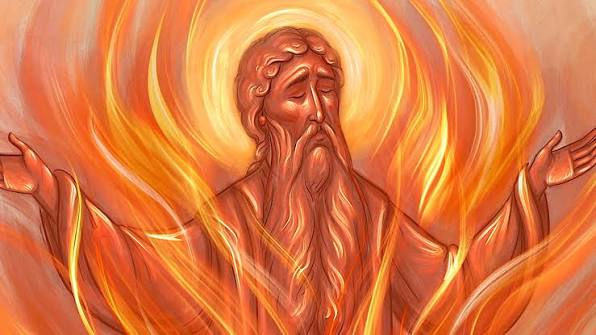
And because they remained, fire came.
Not the fire of self-importance.
The fire of the Holy Spirit.
The fire that burns away illusion.
The fire that teaches a man how to love.
The fire that makes the heart spacious enough for God and for the suffering of the world.
And perhaps that is where Pentecost truly begins:
Not in noise.
But in a heart that has finally become poor enough to wait for God alone.


A few years ago, as I was moving into a new place, I decided to eliminate mirrors. I had one head shot mirror in the bathroom and that was it. The intention was freedom, and it worked well…until the next vanity project crept in. I started using my cell phone or ipad camera as a mirror. How minimalist and brilliant, right? Except that now I had a snapshot to examine----from this angle...from that angle…and video that was now the catwalk…and I can flip between “how you see yourself” vs “how others see you”.... Unfortunately, the vanity doesn’t die when you remove the mirrors; it finds another surface. Sometimes worse than the first.
Oftentimes, in our modern backwards world, which i…