_edited.jpg)
The Cell Where God Waits
A Dialogue Between St. Charbel and a Disciple on the Life of a Hermit
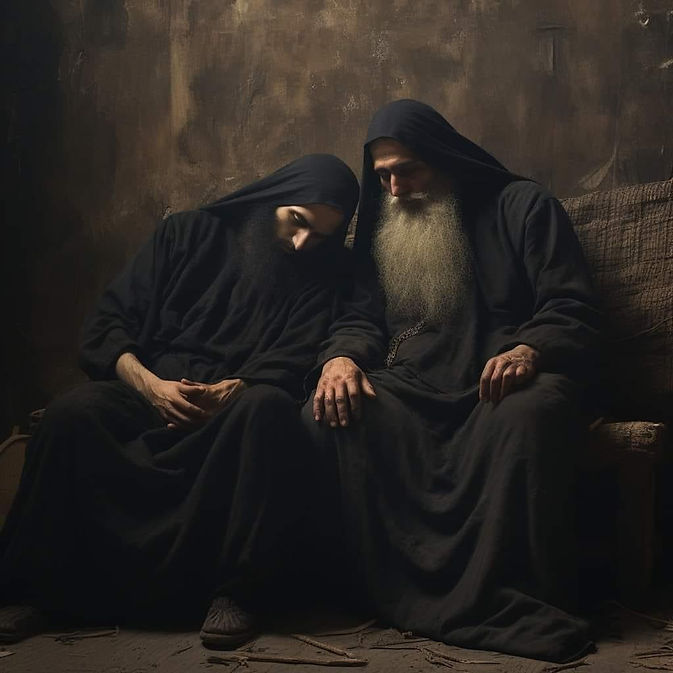
“Go into your cell, and your cell will teach you everything.”
— Apophthegmata Patrum
The disciple approached the old hermit as evening settled over the mountains. The cedars stood motionless against the fading sky, and from within the little stone cell came only silence.
“Father,” he said softly, “many speak of the beauty of the hermit’s life. They imagine peace, freedom, and an intimacy with God that cannot be found elsewhere. Tell me, what is the life of a hermit?”
St. Charbel looked at him for a long moment before speaking.
“My son, if you seek beauty, you will not endure it. If you seek solitude because it seems peaceful, you will flee from it before long.”
The disciple lowered his eyes.
“Then why does one become a hermit?”
“To allow God to remove every place where we have hidden from Him.”
The disciple was surprised.
“I thought a hermit withdraws from the world.”
“He withdraws from nothing except illusion.”
The old monk folded his hands.
“The world is not merely outside you. The greater world is within—the countless voices, memories, fears, ambitions, injuries, judgments, fantasies, and desires that keep the heart in continual motion. You may flee to the highest mountain and still carry an entire city within your breast.”
“Then solitude reveals what has always been there?”
“It reveals what noise concealed.”
Silence settled between them.
After a while the disciple asked, “Is that why so many fear silence?”
“Yes.”
“They think they fear loneliness.”
“They fear truth.”
The disciple pondered this.
“I often imagine that if only I had enough silence, prayer would become easy.”
St. Charbel smiled.
“No, my son. Prayer becomes simple, not easy.”
“What is the difference?”
“When everything unnecessary begins to fall away, you discover how deeply you have relied upon it. You have leaned upon activity, conversation, admiration, knowledge, even religious works. In solitude God gently removes each support until you learn to stand only in His love.”
“That sounds painful.”
“It is painful only to the false self.”
“And the true self?”
“The true self has been waiting for this all along.”
Again silence.
The disciple finally spoke.
“Father, what does a hermit actually do all day?”
The old monk laughed quietly.
“He remains before God.”
“But surely there is more.”
“There is work, prayer, fasting, reading, manual labor, rest, kindness to those whom Providence sends. But these are not separate things. Everything becomes one offering.”
He picked up a handful of earth.
“The farmer turns the soil.”
He let it fall slowly through his fingers.
“The hermit allows God to turn the soil of his heart.”
“And what grows there?”
“If he does not interfere…”
“What grows?”
“Christ.”
The disciple’s face brightened.
“I long for that.”
“Do not long for extraordinary experiences.”
“What should I long for?”
“To belong entirely to Christ.”
“Is there a difference?”
“The first still seeks something for itself.”
“And the second?”
“Seeks only Him.”
The disciple hesitated.
“Father…is it selfish to leave the world behind?”
St. Charbel became very still.
“A heart united to Christ never leaves the world.”
“I do not understand.”
“The hermit carries the world where it belongs.”
“Where is that?”
“Into the Heart of God.”
“So the hermit loves everyone?”
“If he is truly a hermit, he cannot do otherwise.”
“But he sees almost no one.”
“Love is not measured by proximity.”
“How then?”
“By communion.”
The disciple reflected on these words.
“Then hiddenness is not an escape.”
“No.”
“It is another form of service.”
“It is deeper than service.”
“What is it?”
“Participation.”
“In what?”
“In Christ’s own hidden life.”
The disciple looked toward the tiny chapel.
“So Nazareth was already the life of a hermit?”
“In many ways.”
“But Christ lived among others.”
“Yes.”
“And yet no one knew Him.”
The old monk nodded.
“Learn this well. Hiddenness is not determined by geography but by humility.”
The disciple remained quiet for a long time.
“Father…what is the greatest danger for a hermit?”
The answer came without hesitation.
“To begin thinking he has become one.”
The disciple smiled.
“You mean pride.”
“I mean forgetting that without grace he is only a lonely man.”
The old monk continued.
“The devil does not care whether you live in a monastery or a city. He only asks that you admire yourself.”
“And humility?”
“Humility forgets itself because it is looking at Christ.”
The disciple’s eyes filled with tears.
“Will I ever become such a man?”
St. Charbel answered gently.
“If every day you consent to become a little smaller, Christ will become a little more visible.”
“Must I accomplish great things?”
“No.”
“Must I become known?”
“No.”
“Must I understand everything?”
“No.”
“What then?”
“Remain faithful.”
The disciple whispered,
“Faithful to what?”
“To the hour God has given you.”
He pointed toward the lamp burning before the Blessed Sacrament.
“Do not ask to illuminate the whole world.”
“What should I ask?”
“That your own flame never go out.”
Night had now fallen completely.
The disciple rose to leave.
“Father, give me one final word about the hermit’s life.”
St. Charbel closed his eyes for a moment before speaking.
“The hermit is not a man who has found solitude.”
He opened them again.
“He is a man whom Christ has found in solitude.”
“And what becomes of him?”
“He slowly disappears.”
The disciple looked puzzled.
“Disappears?”
“So that when others look toward the mountain, they no longer speak of the hermit.”
“But of Christ.”
And the old monk returned to silence, which was the final lesson he had to give.

Comments