_edited.jpg)
Fall Retreat: To Become All Flame
Updated: Sep 4
Desire, Freedom, and the Transformation of the Heart
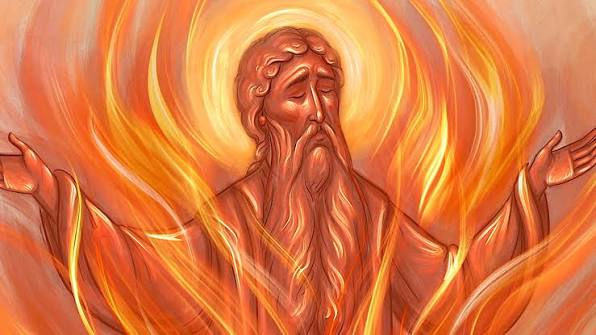
A Four-Week Retreat with the Desert Fathers and St. Isaac the Syrian
UPDATED SCHEDULE Sept 12, 19, 26 and Oct. 3
7:00–9:00 PM EDT
Register online at PhilokaliaMinistries.org
“Abba Joseph stretched his hands toward heaven, and his fingers became like ten lamps of fire, and he said to Abba Lot: ‘If you will, you can become all flame.’”
— The Sayings of the Desert Fathers
There is something startling about this ancient story.
Abba Lot comes to Abba Joseph and tells him that, as far as he is able, he keeps his little rule. He fasts, prays, meditates, lives in stillness, and tries to purify his thoughts. Then he asks a question that has echoed through the centuries:
“What else can I do?”
Abba Joseph rises. He stretches his hands toward heaven. His fingers become like ten lamps of fire.
And he says:
“If you will, you can become all flame.”
We may hear such a story and immediately place it safely among the extraordinary tales of the Desert Fathers. We admire it. Perhaps we marvel at it. And then we quietly assume that it has very little to do with us.
But what if Abba Joseph is revealing not an extraordinary vocation, but the deepest meaning of the Christian vocation itself?
Christ tells us:
“I came to cast fire upon the earth; and would that it were already kindled!”
— Luke 12:49
Christianity is not simply the acquisition of religious knowledge, the fulfillment of obligations, or even the cultivation of virtue. All of these have their place. But they exist for something greater.
We have been created for communion with God.
And communion transforms us.
The Fathers sometimes compared this mystery to iron placed within a furnace. The iron remains iron, yet gradually it becomes incandescent. It takes on the heat and radiance of the fire surrounding it.
So too the human person.
We do not cease being human when grace fills us. We become fully human. The heart becomes capable of bearing the life of God. Desire is purified. Prayer deepens. The passions lose their tyranny. Compassion expands. Fear begins to loosen its hold upon us. Gradually, the human person becomes what he was created to be: a living icon of divine love.
This is the mystery the Eastern Fathers call theosis.
And perhaps we need to recover its audacity.
There is a temptation in every age to domesticate the spiritual life. Christianity can gradually become something manageable—a collection of practices, obligations, institutions, programs, and ideas. Even asceticism itself can become another religious accomplishment.
Yet the Desert Fathers continually lead us somewhere more dangerous.
They lead us toward desire.
They ask us what we actually want.
St. Isaac the Syrian understood that the deepest movement of the spiritual life is not fear but love—not merely discipline but desire and wonder. We seek God because we have first been sought by Him. Something awakens within the heart because the Divine Lover has already touched it.
At some point, therefore, a person may discover that simply “being religious” no longer satisfies the heart.
He wants God.
Not experiences of God.
Not usefulness to God.
Not recognition for serving God.
God Himself.
It was this desire that drove men and women into the deserts of Egypt, Palestine, and Syria. They were not initially attempting to establish a religious institution called monasticism.
They were following a hunger.
The forms came later.
First came the fire.
Yet not every strong desire comes from God. The Fathers knew this better than anyone. Desire must be purified. Thoughts must be tested. Freedom must be distinguished from self-will. The person seeking God must learn obedience, patience, humility, repentance, and the willingness to remain hidden.
But discernment is not the same thing as domestication.
The purpose of discernment is to discover whether the fire is from God—not simply to extinguish whatever exceeds our expectations.
This four-week retreat will explore this mystery through Scripture, the Desert Fathers, St. Isaac the Syrian, and the witness of the great spiritual elders of the Church.
It is not a retreat about extraordinary mystical experiences.
It is about something simultaneously simpler and more demanding:
What would happen if we actually allowed God to have the whole heart?
⸻
Night One — The Spark
“I Have Come to Cast Fire upon the Earth”
We begin not with our desire for God, but with God’s desire for us.
Before we sought Him, He sought us. Before the heart began to hunger, grace had already touched it.
Drawing especially upon St. Isaac the Syrian, we will consider divine eros, desire, wonder, and the mysterious awakening by which a person begins to realize that nothing finite can finally satisfy the heart.
We will ask what it means to move beyond a Christianity governed principally by obligation toward a life drawn by love.
The first movement belongs always to God.
He strikes the spark.
⸻
Night Two — The Desert
“One Thing Is Necessary”
Why did the Fathers go into the desert?
Before there were monasteries, rules, habits, institutions, and organized forms of monastic life, there were men and women possessed by a desire for God.
Antony heard the Gospel and went.
Arsenius heard the words:
“Flee, be silent, pray always.”
Others followed.
This evening will explore the desert not primarily as a geographical location, but as the movement of the heart toward simplicity and undividedness.
What must become quiet within us if we are to hear God?
What must be relinquished?
How do we discern genuine movements of the Spirit without confusing freedom with spiritual individualism—or allowing fear to extinguish what God may be awakening within the heart?
The desert asks a question our age finds difficult:
What if God Himself is enough?
⸻
Night Three — The Furnace
“Give Blood and Receive the Spirit”
Desire alone is not sufficient.
Fire purifies.
The Fathers understood that the heart which desires God must pass through a furnace: the confrontation with the passions, self-will, illusion, fear, pride, resentment, and the countless ways in which we seek to possess even our spiritual lives.
Here we will explore obedience, repentance, asceticism, suffering, waiting, and discernment.
In particular, we will distinguish freedom from autonomy.
Autonomy says:
No one will tell me what to do.
Spiritual freedom says:
Nothing will prevent me from belonging completely to God.
The desert is therefore not an escape from obedience. It is the discovery of its deepest meaning.
The fire that warms must also consume.
⸻
Night Four — All Flame
“If You Will…”
We return finally to Abba Joseph and Abba Lot.
What does it mean to become all flame?
Not visions.
Not extraordinary ascetical accomplishments.
Not mystical experiences reserved for a spiritual elite.
It is the transformation of the human person by grace.
The mother who gives herself quietly in love can become all flame.
The monk praying unseen in his cell can become all flame.
The person caring for the suffering can become all flame.
The Christian whispering the Name of Jesus in the darkness can become all flame.
The dying person surrendering himself into the hands of Christ can become all flame.
Because the fire is love.
We will conclude by exploring theosis, Pentecost, the Jesus Prayer, and the transformation of the heart into a place capable of bearing the presence of God.
Perhaps we will discover that Abba Joseph’s words were never intended merely to astonish us.
They were an invitation.
After all our prayer, reading, asceticism, searching, struggling, falling, repenting, and beginning again, we may eventually find ourselves standing beside Abba Lot asking:
Is there something more?
The old man does not give us another program.
He does not give us another technique.
He raises his hands toward heaven.
And suddenly they are burning.
“If you will, you can become all flame.”
Perhaps the great question is not whether such a life is possible.
Perhaps the question is whether we still desire it.


Comments