
While He Was Speaking of the Cross
The terrible ease with which we can stand beside Christ and still be occupied with ourselves
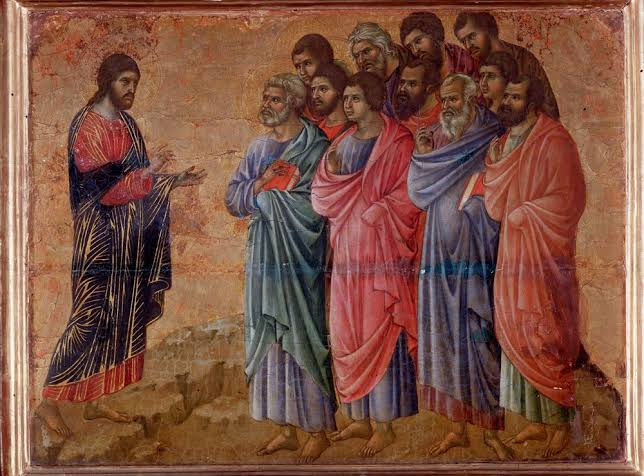
“Let these words sink into your ears; for the Son of man is to be delivered into the hands of men.”
— Luke 9:44
There is something almost unbearable in the sequence of this Gospel.
Jesus tells the disciples what is about to happen to Him.
He does not speak vaguely. He tells them that He will be delivered into the hands of men. A darkness is already gathering around Him. Betrayal, humiliation, violence, abandonment, the Cross—all of it lies before Him.
And the disciples begin arguing about which of them is the greatest.
We should resist the temptation to judge them too quickly.
The Gospel has preserved this moment because it knows us.
Christ is speaking of His suffering, and they are thinking about themselves.
He is descending.
They are wondering who will ascend.
He is moving toward dispossession.
They are concerned with position.
And perhaps most painfully, they are standing beside Him while doing it.
This is one of the great dangers of the spiritual life: we can remain very near to holy things while becoming strangely insensitive to God.
The fathers understood this with frightening clarity.
They knew that a person could pray and still be filled with self-love. He could fast and secretly measure himself against another. He could acquire theological knowledge and become harder rather than more merciful. He could speak beautifully about humility while arranging the world around his own importance.
The desert stripped away these illusions.
The question was never merely whether a man prayed.
The question was what prayer was doing to him.
Was he becoming smaller?
Was he becoming more merciful?
Was he less interested in being seen?
Could he rejoice when another was praised?
Could he remain at peace when forgotten?
Could he recognize Christ when Christ appeared in a form that offered him nothing?
These are far more terrible questions than whether we have kept our rule.
The disciples hear that Christ will suffer, but immediately their attention returns to themselves.
This is precisely what self-love does.
It makes us unable to perceive the suffering of the person standing before us because we are too occupied with our place in the room.
We may imagine that hardness of heart means cruelty.
Often it is something quieter.
It is simply being preoccupied with ourselves.
Someone is grieving, and we are wondering what they think of us.
Someone is afraid, and we are preparing our answer.
Someone is carrying a burden, and we are comparing their life with ours.
Christ is speaking of the Cross, and somewhere inside us an argument is taking place about who is greatest.
The fathers would not allow us to sentimentalize this.
They would tell us to look directly at it.
Much of what we call spiritual struggle is the slow uncovering of how deeply the self wishes to remain at the center—even in our relationship with God.
We want grace, but we want to possess it.
We want holiness, but we want to know that we are becoming holy.
We want humility, provided someone notices it.
We want to follow Christ, but some hidden part of us still wants to know where we stand among the other disciples.
And Christ does something extraordinary.
He does not answer their argument with an argument.
He brings a child beside Him.
The child possesses no rank.
No achievement.
No authority.
No spiritual résumé.
Nothing that would make the child useful in the disciples’ competition.
And Jesus says, in effect:
Receive this one.
Here is your greatness.
The Kingdom is revealed in what the ambitious heart overlooks.
The least.
The dependent.
The unnoticed.
The person from whom there is nothing to gain.
This is why the desert fathers placed such weight upon hospitality, mercy, bearing with weakness, refusing judgment, and relinquishing one’s own will. These were not secondary virtues added to the “real” work of prayer.
They were the revelation of whether prayer had become real.
A man could spend the night reciting the Psalms and discover the condition of his heart the next morning when a brother interrupted him.
The interruption revealed more than the vigil.
Then the Gospel becomes sharper still.
John tells Jesus that they saw someone casting out demons in His name and tried to stop him.
Why?
“Because he does not follow with us.”
There it is again.
Us.
Our group.
Our place.
Our legitimacy.
Our boundaries.
Even the name of Jesus can become something around which the ego constructs territory.
The disciples have moved almost seamlessly from asking who among them is greatest to deciding who belongs within their circle.
Christ is walking toward the Cross while they are drawing borders around themselves.
The contradiction is devastating.
And we should allow it to remain devastating.
For the Cross destroys precisely this world of comparison, possession, rivalry, and self-importance.
Christ does not cling to His place.
He empties Himself.
He does not defend His status.
He descends.
He does not establish His greatness by placing others beneath Him.
He kneels before them.
Perhaps this is why the disciples cannot yet understand what He is saying.
The Cross cannot finally be understood by explanation alone.
It must dismantle something in us.
Until then, we can hear the words without hearing them.
“Let these words sink into your ears.”
There is almost sorrow in the command.
Listen.
Something terrible and beautiful is being revealed to you.
Stop thinking about yourselves long enough to see it.
This may be one of the fiercest invitations of the Gospel.
To notice the person before us.
To notice the sorrow we have been too preoccupied to see.
To notice the child standing beside Christ.
To notice the goodness occurring outside the boundaries we have drawn.
To notice Christ Himself moving quietly toward the Cross while we have been occupied with our importance.
The modern elders repeatedly return us to this simplicity. Do not search for extraordinary states. Do not imagine that holiness consists in acquiring something impressive. Attend to the person God has placed before you. Bear a little of another’s burden. Refuse the thought that makes you greater than your brother. Repent quickly. Begin again.
The deepest repentance may sometimes begin with a very simple realization:
I did not see you.
I was standing beside you, and I did not see what you were carrying.
There is no need to despair when we discover this blindness.
But neither should we excuse it.
We turn.
We ask for mercy.
And perhaps slowly the heart becomes quiet enough to notice what it once overlooked.
Christ is still placing the little one beside Him.
Christ is still working beyond the boundaries we draw.
Christ is still descending while we are tempted to ascend.
Christ is still speaking of the Cross.
The question is whether, this time, we will hear Him.
And whether, having heard Him, we will finally look away from ourselves long enough to see Him.


Comments