_edited.jpg)
Where Does the Soul Live?
The Desire That Already Belongs to Eternity

“The soul from love of the Lord has lost her wits, as it were.”
— St. Silouan the Athonite
Where do we live our lives?
The question seems simple until we allow it to expose us.
We can live in the world without the world being the place where our heart dwells. We can inhabit a house, fulfill our responsibilities, care for those entrusted to us, endure uncertainty, carry grief, answer the demands of each day, and yet inwardly live somewhere else altogether.
The true dwelling place of a human being is revealed by desire.
Where does your heart go when nothing is demanding its attention? What does it seek when it is left alone? What absence causes it pain? What presence would be enough?
For St. Silouan, the answer became almost unbearable in its simplicity:
“All day, all night, my soul is taken up with Thee, O Lord, and I seek Thee.”
This is more than devotion. More even than prayer as we ordinarily understand it. It is a reorientation of existence. God is no longer one among the many concerns occupying the heart. He has become the heart’s country.
And perhaps this is what we are really seeking when we speak of an undivided heart.
Not a life in which nothing difficult happens. Not a life emptied of responsibilities, grief, relationships, uncertainty, or suffering. Rather, a life in which all these things cease to possess the deepest chamber of the heart.
Something, or Someone, has become more important.
Archimandrite Zacharias describes this as the eschatological manner of life. And this is striking because eschatology is often imagined primarily in terms of what will happen later: death, judgment, resurrection, the coming Kingdom.
But the saints speak differently.
Eternity begins wherever desire has already crossed the threshold.
The man who desires God above everything else has begun to live the life of the age to come because his heart already desires what the saints and angels desire. The difference between heaven and earth begins to grow strangely thin.
The cherubim desire God.
The saints desire God.
And somewhere in a hidden room, an unknown soul whispers the Jesus Prayer because it cannot bear to be separated from Him.
Already heaven has begun.
The Pain of Desire
Yet there is something frightening about this.
We often speak about loving God as though increasing love would simply make life more peaceful. St. Silouan tells us something considerably more demanding.
Divine love can become so intense that the soul seems to lose its wits.
It sits silently.
It looks upon the world almost as though it no longer sees it.
Others may think nothing is happening. Yet inwardly the soul is contemplating the One it loves.
This is not contempt for creation. Nor is it psychological withdrawal. It is what happens when the relative is finally seen in the light of the Absolute.
The world may remain beautiful.
Friendship remains beautiful.
Human affection remains beautiful.
Work, art, nature, memory, home . . . all can remain beautiful.
But they cannot satisfy the heart.
Once the soul has tasted God, created things are relieved of the impossible burden of being God for us.
And so St. Silouan can say that nothing earthly can satisfy the soul that has known Him.
This is freedom.
But it hurts.
The soul discovers within itself a capacity for God so immense that everything finite begins to reveal its limits. Even the most beautiful created thing eventually says to us:
I am not He.
And if we receive that truth rightly, it does not diminish the thing. It makes it transparent.
We begin to love creation without demanding eternity from it.
When the World Is Left Behind
St. Symeon the New Theologian describes divine love overtaking him so completely that outward things recede from his awareness. Having encountered the beauty of undefiled love, he finds himself no longer passionately drawn toward earthly beauty.
This is the strange dispossession produced by divine eros.
God does not merely command us:
Give these things up.
He reveals Himself.
And suddenly the question becomes:
Why was I trying to live on these things when this was what my soul wanted all along?
This is why genuine asceticism cannot finally be sustained by negation.
Renunciation alone will exhaust us.
Discipline alone will harden us.
Willpower alone will eventually fail us.
Something stronger must seize the heart.
Desire must overcome desire.
The Fathers understood this profoundly. The soul becomes free not simply because it has learned to say no, but because it has discovered the One to whom it desperately wants to say yes.
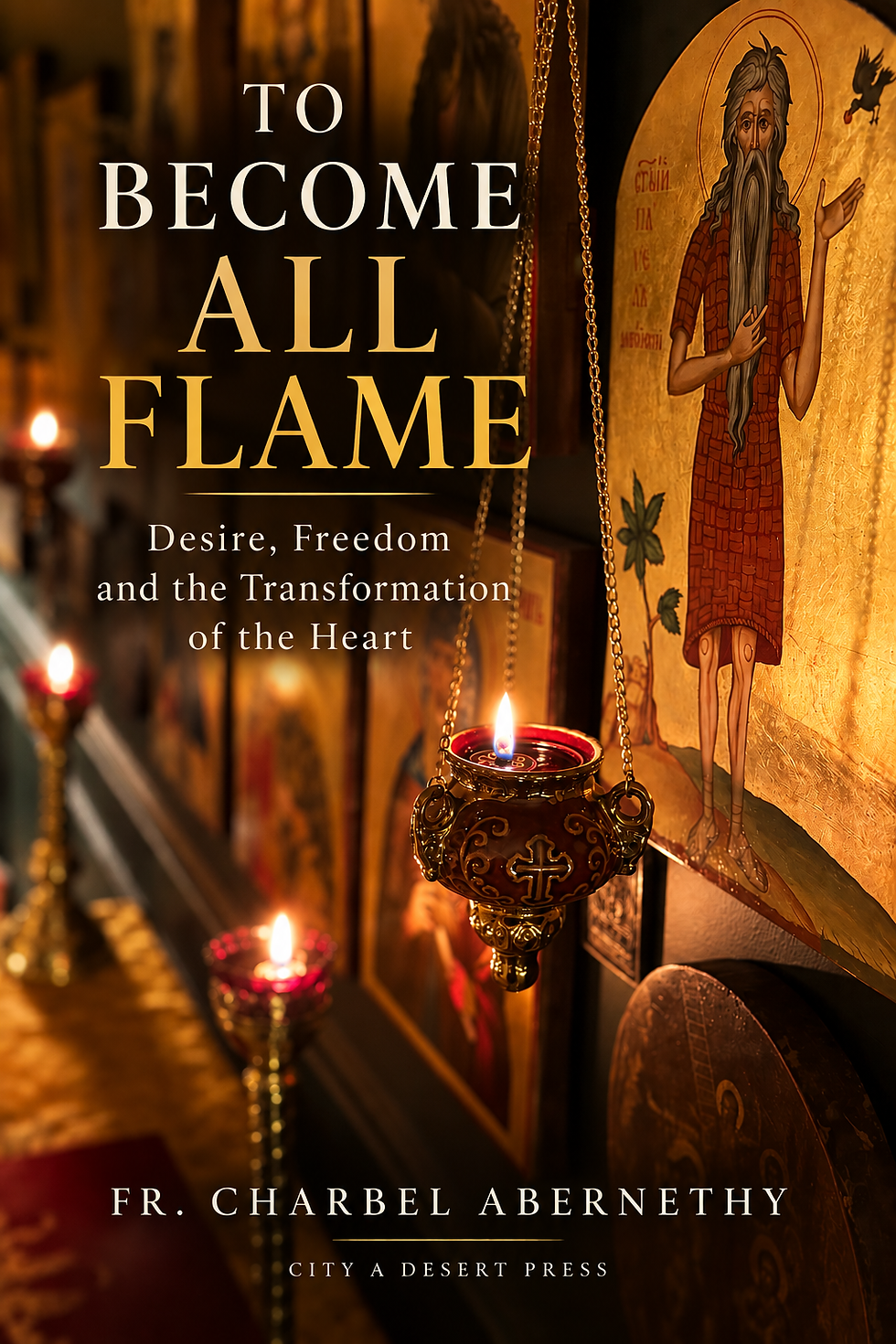
“If you will, you can become all flame.”
Perhaps the fire begins here.
Not with extraordinary ascetic feats, but with allowing the deepest desire of the heart to emerge from beneath the thousands of smaller desires that have concealed it.
I want God.
Not merely His consolation.
Not certainty about the future.
Not a perfectly ordered life.
Not recognition.
Not vindication.
Not even the resolution of every unanswered question.
Him.
And when this desire becomes strong enough, it begins gathering the scattered fragments of the person into itself.
The divided heart slowly becomes one.
The Tears of Those Who Cannot Yet Love Enough
There is another beautiful element in these passages: tears.
We ordinarily weep because something has been taken from us.
But there are tears born because God has not yet been loved enough.
The soul sees something of His goodness and simultaneously sees its own poverty. It recognizes how little gratitude it has offered, how distractedly it has lived, how frequently it has preferred lesser things.
And it weeps.
Yet these tears are not despair.
They are already communion.
Zacharias writes that when we weep over our spiritual poverty, the Lord draws near and covers us with consolation. The tears themselves cleanse the sight of the heart until His form becomes clearer.
Then the paradox deepens:
The clearer He becomes, the more we desire Him.
The more we desire Him, the more painful His apparent absence becomes.
The greater the pain, the more the heart opens.
And the more the heart opens, the more He fills it.
This is the wound of divine love.
It is terrible and sweet at once.
St. Sophrony observed that without having known great pain, a person cannot bear such sweetness. Perhaps because the heart must first be enlarged before it can receive what God desires to give.
We ask for consolation.
God enlarges the heart.
We ask for peace.
God gives us hunger.
We ask to possess Him.
God teaches us instead to be possessed by Him.
Abide in Me
And here the whole mystery becomes extraordinarily simple.
Remain.
Abide.
Do not run away from the desire.
Do not immediately turn it into another project.
Do not try to determine what it means for tomorrow.
Remain with Him today.
Christ does not say, Understand everything that I am doing.
He says:
“Abide in Me, and I in you.”
Perhaps the greatest temptation comes precisely here. Once the soul begins sincerely seeking an undivided heart, everything that remains divided within it becomes visible.
Concerns multiply.
Old fears awaken.
Circumstances press upon us.
Other people’s judgments disturb us.
Questions about the future demand answers.
Even legitimate responsibilities threaten to occupy the sanctuary of the heart.
And we think something has gone wrong.
Perhaps nothing has gone wrong.
Perhaps the desire is being tested.
Not tested so that God may discover whether it is genuine. He already knows.
Tested so that we may discover what we actually desire.
Again and again the question returns:
Where will you live?
In tomorrow?
In what others think?
In what might happen?
In what has been lost?
In what remains unresolved?
Or here . . .
with Me?
The cell is ultimately not a geographical location.
The desert is not finally an address.
The hermitage cannot protect the heart if the heart has not learned where to dwell.
The true cell is Christ.
Already There
This gives extraordinary meaning to the hidden life.
A person may outwardly appear to be doing almost nothing. His life may have narrowed considerably. The world may consider his sphere of activity small.
But inwardly an immense migration may be taking place.
The soul is moving from time toward eternity.
From multiplicity toward simplicity.
From self-possession toward surrender.
From distraction toward remembrance.
From longing for many things toward longing for One.
And gradually the distinction between this life and the life to come begins to change.
What will heaven be?
God.
What does the soul desire now?
God.
What will occupy the saints eternally?
God.
What increasingly occupies the heart now?
God.
Then eternity is no longer merely waiting on the other side of death.
The soul has begun to live there already.
This is eschatology not as speculation but as transformation.
The Kingdom comes secretly into the heart through desire.
And perhaps this explains the strange gaze of Silouan’s soul - the soul that has “lost her wits.” She looks upon this world but no longer expects from it what only the Kingdom can give.
She has discovered her homeland.
She still lives here.
She still loves.
She still serves.
She still suffers.
She may carry responsibilities that cannot be abandoned and sorrows that cannot be resolved.
But something fundamental has changed.
She no longer lives from here.
Her life is hidden elsewhere.
One Desire
There comes a point when even the desire for God must cease being merely our desire.
It becomes participation in His desire.
Zacharias describes the life of God Himself as an unimaginable intensity of self-emptying communion - the eternal movement of love within the Holy Trinity, utterly without self-seeking.
God loves “unto the end.”
And the human heart is invited into that movement.
This is why the deepest longing for God eventually enlarges rather than contracts the heart. Silouan does not end by asking God merely to satisfy his longing.
His heart has become vast.
He prays for the whole universe.
This is one of the surest signs that divine eros is genuine.
The soul that truly loses itself in God does not become indifferent to others.
It discovers them in Him.
The solitary becomes strangely universal.
The hidden prayer becomes cosmic.
The tears shed before God become tears for Adam.
The heart that wanted only God discovers within God every human person.
And so the final movement is not escape from the world but its recovery in Christ.
Perhaps this is where the desire for an undivided heart ultimately leads.
Not toward having nothing to love.
But toward loving everything in the One.
And then perhaps the question with which we began becomes clearer.
Where do we live our lives?
We live wherever our desire dwells.
And what does our soul desire?
If beneath every other longing there is slowly emerging one terrible, beautiful, consuming desire,
My soul yearns after Thee,
then perhaps something eternal has already begun.
Perhaps the soul is already standing at the threshold.
Perhaps the fire has already been kindled.
And perhaps the only thing necessary is not to flee from it.
Remain.
Let the lesser desires fall away.
Let the heart ache.
Let it be enlarged.
Let it learn the madness of divine love.
Until there is nothing left in us that does not say:
I seek Thee.
And nothing left in us that does not burn.


Comments