_edited.jpg)
When the Heart Sees Who Has Come Near
Strength, Wonder, and the Desire Born of Divine Love

“He is my love, my fortress;
he is my stronghold, my saviour.”
— Psalm 143 (144):2
There is a way of hearing this psalm that can leave us almost entirely with the language of warfare. The Lord trains the hands for battle. He is fortress, stronghold, shield and refuge. Enemies surround us; mighty waters threaten to overwhelm us; falsehood rises against us. We cry out for God to descend, to scatter what assails us and to draw us from the deep.
All of this is true. The Fathers knew the battle of the heart with a sobriety that our age has largely lost. They knew how quickly a thought can become a passion, how easily the mind can be carried away, how relentlessly the demons seek to disturb the heart and draw it from remembrance of God. The Desert Fathers speak of vigilance because they understood that there is no moment in this life when we cease to need God. Saint Isaac likewise refuses every illusion of spiritual self-sufficiency. Until our final breath, we remain poor, vulnerable, dependent upon grace.
Yet the heart of the psalm is not found simply in the strength God gives us to fight.
It is found in the astonishing confession:
“He is my love.”
Perhaps everything else must be read from there.
God does not teach us watchfulness so that we might spend our lives staring anxiously into the darkness, cataloguing temptations and measuring the strength of our enemies. He teaches us watchfulness so that nothing may steal from us the sight of Him. The tragedy of distraction is not merely that it makes us less disciplined. It is that it turns the eyes of the heart away from the One who loves us.
The desert is not ultimately a school of combat. It is a school of desire.
This is what Saint Isaac continually draws us toward. Beneath his ascetic severity there burns an almost unbearable tenderness. His teaching concerning vigilance, tears, prayer, compunction and purification is never an end in itself. The heart is being cleared because it was created to behold God. And when the heart begins truly to see Him, something greater than fear awakens within it.
Wonder.
“Lord, what is man that you care for him, mortal man, that you keep him in mind?”
We have heard words such as these so often that we can cease to feel their strangeness. I am a breath. My life passes like a shadow. Everything I possess will disappear. My body will return to the earth. I cannot secure even the next moment of my existence.
And yet God remembers me.
The One who made heaven and earth bends His attention toward this passing creature. He knows him. He seeks him. He guards him. He descends toward him.
The psalmist can hardly contain the wonder of it:
“Lower your heavens and come down.”
And this is precisely what God has done.
The Christian life begins to change when this ceases to be merely a theological assertion and becomes the astonishment of the heart. God has come down. He has entered our poverty. He has taken flesh. He has entered our suffering and death. He has descended even into the places within ourselves from which we would instinctively turn away.
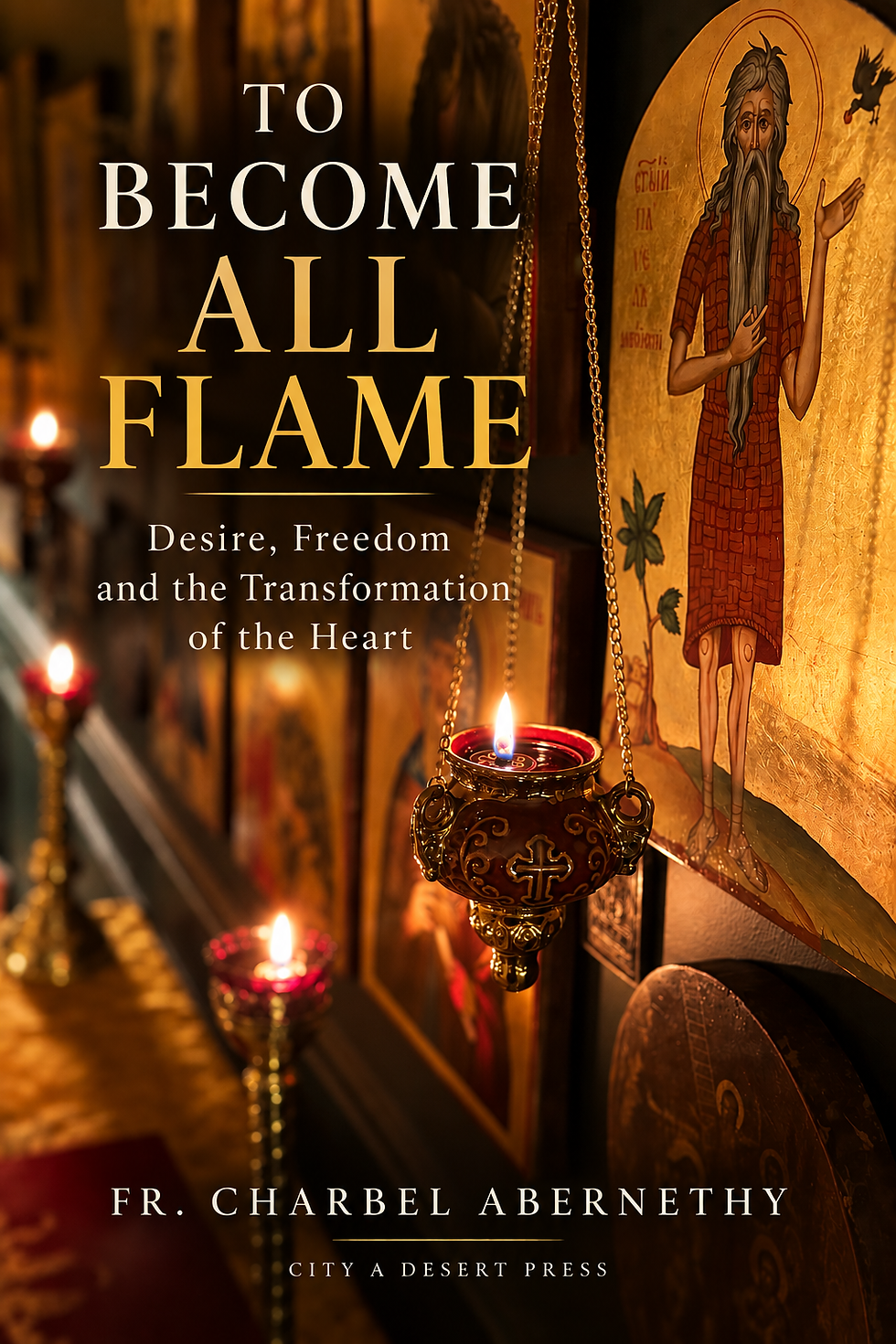
The Fathers of the desert withdrew from the world not because creation had become hateful to them, but because they had glimpsed something so beautiful that they wanted nothing to obscure it. Abba Arsenius hears, “Flee, be silent, pray always,” because the heart must become quiet enough to discover what it truly desires. Abba Joseph raises his hands and becomes as flame because the end of asceticism is not merely restraint but transformation: the whole human person set ablaze by God.
“If you will, you can become all flame.”
But where does this flame begin?
It begins when the heart realizes that it has first been loved.
Saint Isaac returns again and again to this primacy of divine mercy. We do not create the love that carries us toward God. We awaken to a Love that has already bent over us. Grace precedes desire. Mercy surrounds repentance. God’s longing for the human person precedes every movement of the human heart toward Him.
This is why wonder is so essential to the spiritual life.
Without wonder, asceticism can become grim. Vigilance becomes suspicion. Prayer becomes obligation. Obedience becomes mere discipline. The spiritual life slowly contracts into an exhausting attempt to defend ourselves against everything that might harm us.
But when wonder awakens, everything begins to open.
I fast because I have tasted something sweeter.
I keep vigil because I do not want to lose sight of the Beloved.
I guard my thoughts because I have discovered something within the heart worth guarding.
I seek silence because Someone is there.
I repent because mercy has made it possible to look upon my poverty without despair.
I remain because I have begun to understand who remains with me.
This is the movement we find in the great elders of our own time. Saint Silouan’s heart burned with longing for God because he had come to know the tenderness of Christ. Saint Sophrony speaks of the soul stretched toward God with an almost unbearable yearning precisely because it has been touched by divine love. Their asceticism cannot be understood apart from this. They were not men fascinated by spiritual warfare. They were men wounded by beauty.
The heart had seen something.
And after seeing it, nothing else could finally satisfy it.
Perhaps this is why the psalm ends not with another description of battle but with song:
“To you, O God, will I sing a new song.”
This is what happens when deliverance becomes revelation.
At first we cry, “Save me.”
Then gradually we discover who has saved us.
And eventually the heart begins to sing.
The deepest transformation of the spiritual life may occur when our attention shifts from what God is saving us from to the God who has drawn near to save us. The mighty waters may still be there. Temptations remain. Our weakness does not disappear. We are still shadows passing across the earth.
But something else has entered the heart.
Wonder.
Why should You remember me?
Why should You seek me?
Why should You descend into my darkness?
Why should You bear with me through all these years?
Why should You desire me still?
There are no adequate answers to such questions. There is only the incomprehensible mercy of God.
And perhaps it is precisely here that desire and wonder meet.
Wonder looks upon God and says, How can this be?
Desire answers, Then let me belong entirely to You.
The more deeply the heart perceives the love of God, the less asceticism feels like the construction of a spiritual self and the more it becomes the surrender of everything that prevents us from receiving Him. We begin to understand why the Fathers were so uncompromising. They had discovered something for which it was worth relinquishing everything.
The world sees deprivation.
The lover sees freedom.
The world sees the desert.
The lover sees the place of encounter.
The world sees vigilance.
The lover is simply guarding the door through which the Beloved enters.
And so perhaps the greatest grace for which we can ask is not simply greater strength against temptation. It is clearer sight.
To see His presence.
To see His mercy hidden within the ordinary hours of our lives.
To recognize the hand that has held us when we thought ourselves abandoned.
To perceive the patience with which He has waited for us.
To discover that even our longing for Him is already evidence that He has drawn near.
Then the heart begins to understand the psalm differently.
“Blessed be the Lord, my rock.”
Yes, He is my strength.
Yes, He is my fortress.
Yes, He is my refuge.
But before all these things, and within all these things:
He is my love.
And when this truth descends from the mind into the heart, the whole spiritual life changes. We no longer merely seek protection from the things that threaten us. We begin to desire God Himself.
The heart becomes restless for Him.
Silence becomes precious because He is there.
Prayer becomes longing.
Repentance becomes a return to the embrace we have forgotten.
And vigilance becomes the tender attentiveness of the lover who fears only one thing: not suffering, not weakness, not even death, but allowing anything to turn the gaze of the heart away from the One who has loved him from the beginning.
Perhaps this is the new song David sings.
And perhaps it is the song the desert has always been trying to teach us:
You have come down to me.
You have remembered this passing shadow.
You have drawn me from the deep.
You have become my refuge.
You have shown me Your love.
How could I desire anything more than You?


Comments