_edited.jpg)
The Hunger That Sees God
St. Isaac on the Holy Eucharist, Fasting, and the Purity of a Heart No Longer Fed by the World

“Blessed is he who has as nourishment the Bread which came down from Heaven and gave life to the world…”
— St. Isaac the Syrian
There is something fierce in Isaac that our softer religious age often does not know what to do with.
He does not speak of fasting as dieting.
He does not speak of abstinence as discipline for its own sake.
He does not speak of the Holy Eucharist as pious comfort.
He speaks as a man who has seen that there are only two tables.
One feeds life.
The other feeds death.
And most of us try to eat from both.
We want Christ, but we also want constant indulgence.
We want the Bread of Heaven, but we also want our appetites left untouched.
We want purity of heart, but we still keep a quiet friendship with the things that scatter us, stimulate us, entertain us, flatter us, and slowly numb our hunger for God.
Isaac begins with severe mercy:
“Blessed is the man who makes himself deaf to every pleasure that separates him from his Creator…”
Deaf.
Not mildly cautious.
Not “balanced.”
Not politely moderate.
Deaf.
Because there are pleasures that do not merely delight the senses. They divide the soul.
The Desert Fathers understood this with painful clarity. A thing may not be evil in itself, yet if it thickens forgetfulness, inflames passions, strengthens vanity, or makes prayer tasteless, it becomes a veil. St. John Climacus often showed that bondage begins not in great sins, but in subtle consent. The heart slowly loses its simplicity.
Isaac is speaking of purity of heart: not moral polish, but inward singleness. A heart no longer fed by fragmentation.
That is why he immediately turns to the Holy Eucharist.
“Blessed is he who has as nourishment the Bread which came down from Heaven…”
The Eucharist is not merely received. It is meant to become our life.
Christ gives Himself not as symbol, but as food.
What does food do?
It enters us.
It sustains us.
It becomes strength, blood, energy, endurance.
So if Christ is truly our nourishment, then everything begins to change.
We cannot keep feeding endlessly on resentment, distraction, vanity, lust, endless noise, compulsive stimulation, and self-indulgence while imagining we are hungry for Him. A belly full of the world rarely longs for Heaven.
This is why fasting is so fierce and beautiful.
Fasting is not hatred of the body.
It is warfare against false nourishment.
It is the refusal to let appetite become lord.
It is the cry of the whole person:
Only You can satisfy me.
The Fathers knew that the belly is rarely just about food. Beneath gluttony often lies deeper hunger: loneliness, restlessness, fear, boredom, grief, emptiness, the ache to be soothed. We consume because we do not know how to remain poor before God.
So Isaac strikes hard:
“The man who has friends in order to satisfy his belly is a wolf devouring corpses.”
A brutal image.
Because appetite without God becomes predatory.
We begin to use people.
Use comfort.
Use noise.
Use entertainment.
Use religion itself.
Even fellowship can become consumption.
But the man who has seen Christ in his nourishment no longer lives that way.
He can be alone.
He can be silent.
He can be poor.
He can remain unseen.
Because inwardly he is being fed.
Then Isaac says something astonishing:
“The odor of a faster is most fragrant…”
What fragrance?
Not bodily austerity.
The fragrance of inward freedom.
There is a subtle purity around those who are no longer ruled by appetite. The modern elders saw this too. St. Sophrony wrote of how purification widens the heart for divine life. St. Paisios showed that simplicity itself can become luminous. A soul no longer enslaved to pleasure carries peace that cannot be manufactured.
You can often feel it.
A quiet person.
A meek person.
A restrained person.
A person no longer constantly pulled outward.
Their presence rebukes frenzy without saying a word.
That is why Isaac says the greedy feel oppressed by the abstinent man, and those captured by amusements do not love the silent one.
Because purity exposes bondage.
A life ordered around Christ quietly reveals how scattered we are.
And this is perhaps the deepest Eucharistic mystery here:
The Holy Eucharist is not only Bread received at the altar.
It is the beginning of a life where Christ becomes our true nourishment.
Then fasting protects hunger.
Silence guards the heart.
Abstinence loosens passions.
Humility widens the soul.
Purity clears the inner eye.
And little by little, the person begins to hunger less for what dies and more for the living God.
That is why Isaac’s vision is so fierce.
He is not asking whether we are religious.
He is asking:
What table is feeding your soul?
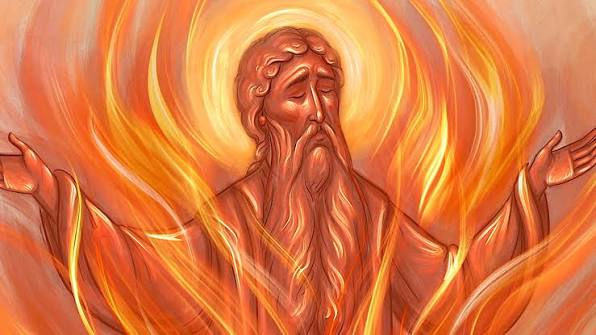


There's only one table of the Lord. Interestingly, it's both a table and an altar.
Newsflash: Everyone is invited to the table.
The altar, where we die to ourselves, consumes the disguise.