_edited.jpg)
The Desert Beneath the Streets
St. Philip Neri and the Expansion of the Heart

“The Kingdom of God is within you.” — Luke 17:21
The desert is not first a place.
It is a heart emptied of everything that cannot receive the love of God.
This is why the Fathers fled into the wilderness. They were not escaping the world so much as seeking that hidden place where the heart might once again become spacious enough to welcome the living God. Their battle was not against cities but against distraction, self-love, and the fragmentation that obscures the image of Christ within us.
In this sense, St. Philip Neri belongs unmistakably among them.
He lived not beneath the palms of Egypt but beneath the streets of Rome. His cave was not the cell of Scetis but the ancient catacombs of St. Sebastian. There, hidden beneath the noise of the Eternal City, he prayed, wept, listened, and allowed God to fashion his heart in silence.
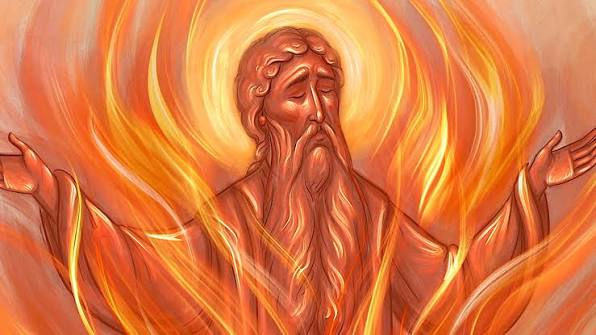
It was there, on the vigil of Pentecost in 1544, that the Holy Spirit descended upon him in an extraordinary way. Philip experienced what he later described only with the greatest reserve: a globe of fire entered his mouth and came to rest within his breast. From that day forward, his heart burned with an almost unbearable love of God. So profound was this transformation that, after his death, it was discovered that several of his ribs had been enlarged and arched outward, apparently making room for his greatly dilated heart.
Whether one emphasizes the physical phenomenon or not, the spiritual reality is unmistakable.
Love had enlarged him.
This is where Philip meets St. Isaac the Syrian.
Isaac never tires of reminding us that the spiritual life begins not with our desire for God but with God’s desire for us. Divine love always comes first. It seeks us before we seek it. It wounds us before we know we have been touched. The whole ascetical life is simply the gradual removal of everything that prevents us from receiving the love that has already been given.
Philip did not manufacture this fire.
He received it.
His years in the catacombs were not an attempt to earn divine love but to become receptive to it. Like the desert Fathers before him, he entered solitude so that the noise within him might grow quiet enough to hear the whisper of the Spirit. The miracle of Pentecost was not the reward for his asceticism. It was the revelation of what God had been preparing in secret.
St. Isaac would understand this immediately.
The heart is not made larger by effort alone.
It is enlarged by love.
The more deeply the soul beholds the tenderness of God, the more incapable it becomes of remaining closed. Fear begins to dissolve. Possessiveness loosens its grip. Judgment gives way to compassion. The narrow confines of the self slowly yield to the vastness of divine mercy.
This is the true expansion of the heart.
Philip carried that desert back into the city.
He did not remain in the catacombs.
He emerged from them.
The silence he had discovered beneath Rome became laughter in the streets, patient listening in the confessional, wise counsel to the young, friendship with artists and laborers, tenderness toward the poor, and a joy so disarming that it drew countless souls toward Christ.
The desert had not separated him from humanity.
It had given him back to humanity.
This too is profoundly Isaacian.
The soul that has encountered divine love does not become less human. It becomes more deeply human. Love widens the heart until there is room for everyone. St. Isaac’s famous image of the merciful heart that burns for every creature finds a remarkable embodiment in Philip. His humor, his gentleness, his refusal to dominate others, and his astonishing freedom all sprang from a heart that had become spacious through the Holy Spirit.
How different this is from the way we often imagine holiness.
We think first of discipline.
The saints think first of love.
We think first of achievement.
They think first of receptivity.
We imagine the spiritual life as climbing toward God.
They discover that God has already descended into the depths of the human heart and waits there to be found.
Perhaps this is why St. Philip remains such a needed saint for our own age.
We live in crowded cities and crowded minds. We are surrounded by constant noise, endless information, and unceasing activity. We often suppose that the desert has become inaccessible.
Philip quietly reminds us otherwise.
There is always a catacomb.
There is always a hidden chamber where the soul may descend to meet the living God. It may be a chapel before dawn, a quiet room in the house, a few faithful moments of the Jesus Prayer, or the silent offering of one’s daily responsibilities. Wherever the heart consents to become still before Love, the desert is present.
And where the desert is found, Pentecost is never far away.
The deepest miracle of St. Philip’s life was not that his physical heart became enlarged.
It was that his entire being became capable of receiving and communicating the inexhaustible love of God.
That remains the vocation of every Christian.
The Fathers sought it in the wilderness.
Philip found it beneath the streets of Rome.
St. Isaac teaches us that it begins whenever we dare to believe that God’s desire for us is greater than our own desire for Him.
Then, quietly and almost imperceptibly, the heart begins to widen.
Not through strain.
Not through accomplishment.
But because Love always makes room for more love.


Comments