_edited.jpg)
The Cry of the Inward Child
St. Isaac, Tears, and the Birth of the Soul into the Air of Grace

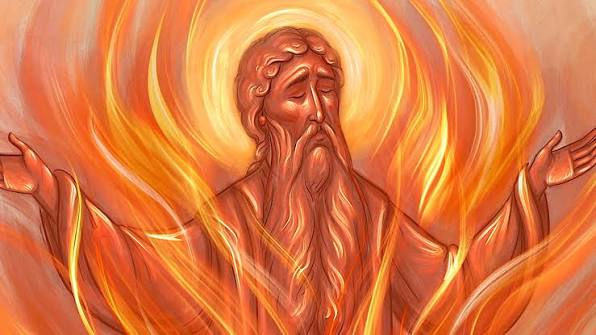
“When you attain to the region of tears, then know that your mind has left the prison of this world and has begun to breathe that other air, new and wonderful.”
— St. Isaac the Syrian
Synopsis of Tonight's Group on The Ascetical Homilies of St. Isaac the Syrian Homily 14
There are passages in the Fathers that do not merely instruct us. They unsettle us because they seem to speak from a place beyond ordinary language. This portion of St. Isaac the Syrian is one of them.
He begins almost defensively, and yet with extraordinary tenderness: “I shall tell you something, and do not laugh, for I speak the truth.” That opening matters. Isaac knows what he is about to describe can sound excessive, mystical, even absurd to the outward or untested mind. He knows some will mock it. Others will reduce it to sentiment or pious exaggeration. He knows he is stepping into something difficult to articulate because the reality itself exceeds words.
And yet he writes.
That itself is striking.
This costs him something.
There is a deeply personal quality here. Isaac is not writing as one giving detached spiritual theory. He writes almost like a father speaking carefully about a mystery he knows language will diminish even as he tries to preserve it. Near the end of the homily he says plainly that he has “taken no little trouble to set these things down.” One feels the labor in that line. Not merely literary labor, but spiritual labor. He is trying to hand on something fragile and luminous to “every man who comes upon this book.” His desire to help souls outweighs the risk of being misunderstood.
And what does he speak of?
Tears.
But not tears as emotional excess.
Not tears as instability.
Not tears as religious theater.
He is speaking of something far deeper: the awakening of the inward man.
Isaac says that until this inward fruit begins, much of our life remains outward. We may pray, labor, fast, study, serve, and yet still remain largely organized around the visible self. The hidden man may still be in service to the world.
Then comes his astonishing image.
When tears begin, the soul has “left the prison of this world.”
Not the world itself.
But its prison.
That inward captivity of self, illusion, hardness, fragmentation, and outwardness.
And then Isaac gives one of the most beautiful images in all ascetical literature: he speaks of the soul almost as an infant being born into another reality.
As an infant in the womb first begins to draw subtle breath before entering this visible life, so the inward man, born of grace through the womb of Mother Church and quickened by the Spirit, begins to perceive another atmosphere.
Another age.
Another reality.
Another air.
He says the soul begins to breathe “that other air, new and wonderful.”
This is breathtaking.
For Isaac, tears are not simply sorrow. They are often the birth pangs of the spiritual child within us. Grace, whom he calls the common mother of all, labors to bring forth the divine image in the soul. And because the mind is unaccustomed to this new reality, the body itself may cry out. Tears become a kind of holy wailing, but “mingled with the sweetness of honey.”
What language.
He is trying to describe something almost impossible: sorrow joined to sweetness, pain joined to grace, birth joined to loss, tears joined to wonder.
The modern mind often has little room for this.
We understand tears psychologically.
We understand grief.
Exhaustion.
Relief.
But Isaac is speaking of something deeper than emotion.
He is speaking of the Kingdom beginning to stir within.
Of the Spirit crying out from depths beyond words.
Of the soul awakening to a reality more real than the visible world.
And yet Isaac remains sober.
He is careful.
He distinguishes passing consolation from deeper compunction. He warns, in effect, against reducing such things to passing feeling or spiritual excitement. He speaks of stillness, of peace of thought, of gradual transition, of hidden maturation. Even here he is restrained.
That restraint matters.
Because what makes this passage so beautiful is not ecstatic excess.
It is tenderness joined to sobriety.
Mystery joined to humility.
Vision joined to caution.
And perhaps most moving of all, Isaac writes not to exalt himself, but to serve.
These things, he says, he has written for himself and for every man who comes upon this book.
That line carries enormous tenderness.
He writes as one who knows words cannot capture the fullness of what grace does, yet he offers them anyway so another soul may not lose courage.
Perhaps that is why this passage still pierces us.
It reminds us that the spiritual life is not merely moral effort, external correctness, or religious performance.
It is birth.
The slow birth of the inward man.
The hidden awakening of the Kingdom.
The Spirit crying from within us.
And perhaps, however faintly, learning to breathe another air.
The air of grace.
The air of the age to come.
The air of Christ.


Comments