_edited.jpg)
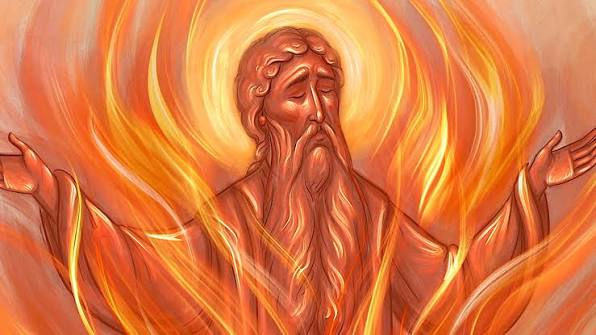
Evagrios the Solitary
The father whose voice still speaks in the silence

“A theologian is one who prays, and one who prays is a theologian.”
Evagrios of Pontus
⸻
He is quoted everywhere.
And named almost nowhere.
His words move silently through the Sayings of the Fathers, through Cassian, through Maximus, through the entire ascetical tradition of the Church. His insights shape the inner vocabulary of spiritual warfare, prayer, and purification. His discernment penetrates into the machinery of the mind and exposes its hidden alliances with pride, fantasy, and despair.
Yet his name faded.
Evagrios the Solitary. Evagrios of Pontus.
A desert father whose influence became so complete that it disappeared into the bloodstream of the tradition itself.
He did not found a monastery like Pachomius. He did not live to extreme old age like Anthony. He did not leave behind dramatic stories of visible struggle. His battle took place elsewhere.
In the invisible.
Evagrios descended into the human mind and found the war already raging there.
He saw what few had the courage or clarity to see. The problem was not merely sin in its outward form. The problem was the thoughts themselves. The hidden movements. The impulses that arose before action, before speech, before even conscious consent.
He called them logismoi.
Eight fundamental patterns of thought that shape the inner life. Gluttony. Lust. Avarice. Sadness. Anger. Acedia. Vainglory. Pride.
Not merely actions.
Forces.
Patterns.
Voices.
He understood that the battlefield of salvation is not the world. It is the heart. And more precisely, the mind within the heart.
A man could flee to the desert and still carry Egypt within him.
Evagrios himself knew this from experience.
He was not born in obscurity. He was brilliant. Educated. Admired. He served the great Cappadocian fathers. He was ordained a deacon by Gregory the Theologian himself. He stood in the center of the intellectual and ecclesial life of his time.
And he nearly lost his soul there.
Ambition. Desire. The subtle intoxication of being seen and admired. He saw in himself the seeds of destruction.
And he fled.
Not to preserve his reputation.
To preserve his heart.
He went into the Egyptian desert and submitted himself to obscurity, to hunger, to silence, to confrontation with the thoughts he could no longer escape.
There, stripped of distraction, he began to see clearly.
He saw that thoughts are not harmless.
They are invitations.
Each thought proposes a world. Each thought offers an identity. Each thought invites consent.
And if welcomed, they reshape the soul.
Evagrios did not merely observe this. He fought it.
He stood guard over his mind with ruthless honesty.
He refused to negotiate with fantasy. He refused to trust the thoughts that flattered him. He refused to build an identity out of spiritual achievement.
He learned to become still.
Not outwardly only.
Inwardly.
He discovered what he called pure prayer. Prayer without image. Prayer without imagination. Prayer without self.
Prayer in which the mind descends into the heart and stands before God naked.
This terrified him.
Because in that nakedness, nothing false survives.
He saw how much of what he called faith was still self-love. How much of what he called devotion was still ambition. How much of what he called knowledge was still ignorance.
And he said the words that echo through the centuries.
A theologian is one who prays.
Not one who speaks about God.
Not one who studies God.
One who stands before Him without defense.
This is why Evagrios became dangerous.
Not because he rebelled against the Church.
Because he exposed the illusions that religious people protect.
He exposed the ego hiding inside asceticism.
He exposed the pride hiding inside knowledge.
He exposed the fantasy hiding inside prayer.
He taught that the goal of the spiritual life is apatheia.
Not emotional numbness.
Freedom.
Freedom from the tyranny of compulsive thought. Freedom from the reflex to defend oneself. Freedom from the endless need to preserve an identity.
Freedom to love.
Freedom to see reality without distortion.
Freedom to stand before God without fear.
But history is rarely kind to those who see too clearly.
His name became entangled in theological controversies not entirely his own. Later disputes about Origen overshadowed his work. His insights survived, but often under other names. Through John Cassian they entered the West. Through Maximus and the later fathers they entered the Orthodox heart.
His thought became foundational.
But his name became quiet.
And perhaps this is fitting.
Evagrios himself sought disappearance.
He did not want disciples who would admire him.
He wanted men who would fight the same war within themselves.
He understood that salvation is not achieved by imitation of outward forms.
It is achieved by truth.
Truth about the thoughts.
Truth about the heart.
Truth about the poverty that exists beneath every spiritual persona.
He remains one of the most mercilessly honest fathers of the desert.
He offers no sentimental comfort.
He offers clarity.
He shows that the enemy is closer than we think.
Not outside.
Inside.
And he shows that Christ is closer still.
Waiting in the silence beneath the noise.
Waiting for the moment when a man stops believing his thoughts.
And begins to pray.
A Note on Evagrios within the Living Tradition of the Church
Evagrios the Solitary stands among the most penetrating physicians of the inner life in the desert tradition. While certain speculative theological expressions attributed to him later required clarification within the Church’s dogmatic life, his ascetical teaching on watchfulness, the warfare of thoughts, and pure prayer was preserved, received, and transmitted by the greatest fathers who followed after him. Through St. John Cassian, St. Maximus the Confessor, St. John Climacus, and the hesychast fathers, his insights became part of the very foundation of Orthodox spiritual life. The modern elders, including St. Silouan, Elder Sophrony, and Archimandrite Zacharias, confirm through their own experience the truths he discerned in the crucible of the desert. The Church, in her wisdom, retained what was born of repentance and prayer, ensuring that Evagrios continues to guide those who seek purity of heart and the grace of true prayer.


Comments