_edited.jpg)
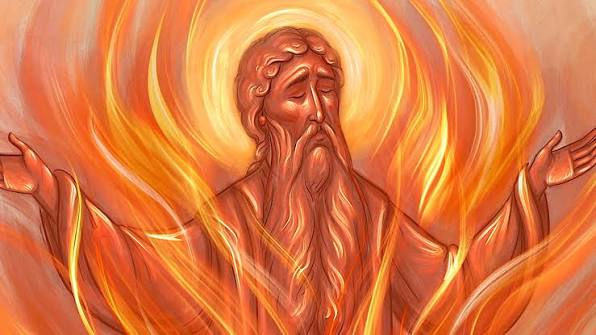
Elijah and the Fire of Silence
Why the Prophet of Carmel Never Left the Desert

“The Lord was not in the wind… nor in the earthquake… nor in the fire; and after the fire a still small voice.”
— 1 Kings 19:11–12
Among the figures of the Old Testament, few have been loved more deeply by the desert fathers than the prophet Elijah. Although they rarely wrote lengthy treatises about him, his presence lingers quietly throughout the ascetic tradition. He is not simply admired as a miracle worker or a fearless defender of the true faith. Rather, he is recognized as one whose whole life was shaped by solitude, prayer, fasting, and the consuming desire for God.
The fathers see in Elijah something essential about the monastic vocation—not merely as a particular way of life, but as the deepest orientation of every Christian heart.
Elijah first appears in Scripture without introduction. He steps onto the stage as one who has already been formed in secret. The hidden years are left veiled from us because they are not an interruption of his mission; they are its source. Before he could stand before kings, he had learned to stand before God.
This pattern would become foundational for the desert tradition.
The monk does not flee into silence because he despises the world. He enters silence because truth can only be received where the heart has become still. Elijah’s years beside the brook Cherith and later on Horeb reveal that God prepares His servants away from applause, away from argument, away even from visible success.
The fathers understood this deeply.
Abba Arsenius, who fled the splendor of the imperial court, did not seek obscurity for its own sake. Like Elijah, he sought to live before the face of God. The desert is not an escape from reality but the place where reality is encountered without distraction.
The ravens feeding Elijah became, for the fathers, an image of divine providence. One who entrusts himself entirely to God discovers that God is never absent. Provision may arrive unexpectedly. It may be hidden. It may even seem insufficient. Yet it is always enough for the one whose confidence rests in God rather than in himself.
The widow’s jar of flour that does not fail teaches the same lesson. Grace is not abundance measured by human standards. It is the quiet fidelity of God sustaining His children one day at a time.
But perhaps nowhere does Elijah become more important to the spiritual life than on Mount Horeb.
After the dramatic fire on Carmel, after the public victory, after confronting falsehood with astonishing courage, Elijah finds himself exhausted, frightened, and longing to die.
The fathers never overlook this moment.
Even the greatest servant of God must pass beyond visible triumph into deeper purification. Miracles do not remove human weakness. Extraordinary experiences cannot sustain the heart forever. God gently leads Elijah beyond zeal into intimacy.
The wind passes.
The earthquake passes.
The fire passes.
Only then does the prophet discover the Voice that cannot be grasped by force or spectacle.
For the desert fathers, this is the movement of every authentic spiritual life.
At first we are captivated by powerful experiences, clear certainties, and visible progress. Yet if God is drawing us toward Himself, He slowly strips away our dependence upon these consolations. He teaches us to recognize Him where the world sees nothing.
Silence becomes full.
Stillness becomes alive.
The hidden presence of God becomes more compelling than every outward manifestation.
Modern elders speak in exactly this way.
St. Silouan the Athonite teaches that the soul must descend into humility before it can know the love of Christ. Elder Sophrony repeatedly insists that genuine theology is born not from intellectual brilliance but from standing before God with the whole person. Elder Aimilianos speaks of the monk becoming a dwelling place for the divine presence through continual remembrance of God.
All of them stand, knowingly or not, in Elijah’s shadow.
His life teaches that divine fire is never opposed to silence.
Indeed, the fire prepares us for silence, and silence allows the fire to become pure love rather than religious excitement.
Perhaps this is why Elijah continues to appear throughout salvation history.
He stands beside Christ on Mount Tabor.
He is expected before the coming of the Messiah.
John the Baptist comes in his spirit and power.
His mantle passes from generation to generation because what he embodies can never disappear from the life of the Church.
The world will always need men and women whose first concern is not activity but communion.
Not influence but obedience.
Not visibility but purity of heart.
The true descendants of Elijah are recognized less by dramatic deeds than by their capacity to hear the gentle voice of God amid the noise of the world.
For that reason, every Christian is invited to become, in some measure, a child of Elijah.
We all have our Cherith.
We all have our Horeb.
We all must learn that the deepest revelations of God are often given not in moments of outward greatness, but in the quiet places where every false support has fallen away and only love remains.
There the fire still burns.
There the Voice is still speaking.
And there, as the desert fathers never tired of reminding us, begins the true life of the heart.


Comments