
Carrying Vespers Home
On the quiet nourishment of standing before God

“Remain in your cell, and your cell will teach you everything.”
— Abba Moses
There are evenings when nothing extraordinary happens, and yet the heart knows that it has been given something necessary.
Vespers in a dim church.
Candles flickering before the icons. The icon screen barely illumined. The movement of incense through the shadows. Psalms and hymns carried upon a chant that seems less to begin than simply to be joined—as though the Church had been singing before we arrived and would continue long after we had gone.
New faces surrounded me, and yet there was something strangely familiar.
The sign of the Cross made again and again. Heads bowed. Bodies bending toward the earth. Voices joining one another without needing to be noticed. There was no need for explanation. The gestures themselves spoke a language the heart somehow recognized.
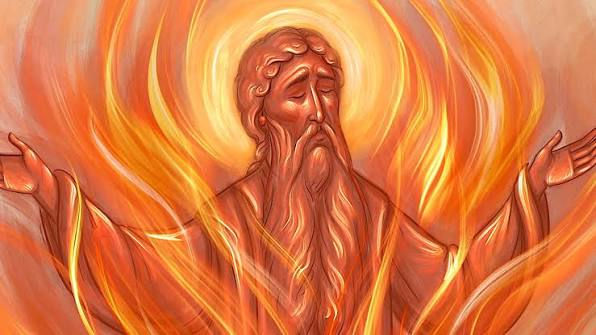
And before me stood the saints.
Among them, St. John Climacus.
I remembered how deeply he had entered my life so many years ago. Long before I understood where the path would lead, there had been the Ladder: repentance, tears, remembrance of death, watchfulness, stillness, prayer. His words had been severe at times, but never cruel. They carried the severity of someone who knows that the human heart was made for God and should not be satisfied with less.
Now there he was before me—not merely as an author whose words had once shaped me, but among that great cloud of witnesses before whom the Church continually prays.

Perhaps this is one of the quiet mercies of the Christian life.
We spend years reading the saints, studying them, struggling with their words, sometimes misunderstanding them. And then, if God is merciful, there comes a moment when we realize that we were never meant merely to read them.
We were meant to stand among them.
The Fathers understood that the soul is formed not only by great decisions but by small movements toward God repeated faithfully.
Light a lamp.
Stand before the icons.
Make the sign of the Cross.
Listen to a psalm.
Bow your head.
Say the Name.
Remain.
The modern elders speak in much the same way. They continually return us from our thoughts about God to the remembrance of God. From theories about prayer to prayer itself. From imagining another life to receiving the place where Christ is already waiting for us.
There is something mercifully undramatic about Vespers.
The day is ending.
Whatever we accomplished is ending with it.
Whatever we failed to accomplish is ending with it as well.
The Church does not ask us to explain the day. She simply gathers it into prayer.
“Let my prayer arise in Thy sight as incense.”
Perhaps this is why such prayer can become nourishment for souls fatigued by the day.
We carry so much.
Conversations unfinished. Responsibilities waiting for morning. Sorrows that cannot be repaired. People we cannot save. Questions whose answers have not yet been given. Even our discernments can become burdens when we begin demanding from them a clarity God has not yet chosen to give.
And then the Church grows dark.
A candle burns before the face of Christ.
The psalms begin.
For a little while, we are permitted simply to stand before God.
Nothing has been solved.
And yet something has been restored.
The Fathers knew this kind of restoration. They fled into the desert not because they despised the world, but because they discovered how easily the heart becomes scattered among many things. They sought the place where the fragments might once again be gathered into the One.
Perhaps most of us will never enter their deserts.
But sometimes the desert comes quietly to us.
A darkened church.
A handful of people praying.
The smell of incense.
An icon illumined by a candle.
A familiar saint looking silently back at us.
And the heart remembering why it was created.
After the final blessing, there was nothing more to do.
Reverence the icons.
Bow before the altar.
Leave quietly.
Then the ride home through the darkness.
But one does not leave Vespers entirely.
The psalms continue somewhere within. A melody returns unexpectedly. The words of a hymn remain beneath one’s thoughts. And on one’s garments there lingers the fragrance of incense—the smallest outward sign that, for a little while, we had stood somewhere else.
Perhaps this is enough.
We often imagine that our souls require something dramatic: an answer, a certainty, a great spiritual experience, some unmistakable indication of the road ahead.
But the saints teach us another way.
Take the next small movement toward God.
Stand before Him.
Pray with His people.
Receive what is given.
Then go home quietly.
Carry the prayer with you.
There is great freedom in allowing God to reveal a life in this way—not all at once, but through fidelity to what is immediately before us.
A psalm.
A candle.
An icon.
A bow.
The Name of Jesus.
The road home.
And perhaps, beneath everything, the heart beginning to recognize something before the mind has found words for it:
Here I can pray.
Here I can become quiet.
Here I can remember God.
Here, among faces newly encountered and hearts somehow familiar, I can stand before Christ and His saints without needing to know what tomorrow will require.
That is no small gift.
For a soul weary from the day, it may be bread.
For a heart scattered among many cares, it may be a gathering.
For one who does not yet know the whole road ahead, it may simply be enough light for the next step.
O Lord, let us see.
And until we see, teach us simply to remain.


Comments