_edited.jpg)
Abide in the Love That Seeks You
From Compunction to Surrender in the Fire of Divine Eros

“We love because He first loved us.”
1 John 4:19
There is a compunction that still circles the self.
Tears can be shed that are secretly about my failure. My weakness. My fall. My loss of image. Even repentance can become a mirror in which I stare at myself. The fathers warn us that the ego is subtle. It will clothe itself even in sackcloth.
The sorrow that leads to life does not end in self absorption. It breaks the heart open. It wounds it so that it can no longer defend itself against Love.
The Lord says, “Abide in My love.” John 15:9. He does not say analyze your wounds. He does not say perfect your religious identity. He does not say construct a self that is worthy of Me. He says abide.
To abide is to remain. To stay. To consent to being loved.
Jeremiah hears the voice of God crying out across time. “I have loved you with an everlasting love. Therefore I have continued My faithfulness to you.” Jeremiah 31:3. Before you repented. Before you wept. Before you built a ministry or destroyed one. Before you sinned in secret or denied Him in public. He loved you.
The tragedy is not that we have sinned. The tragedy is that we prefer our self hatred to His mercy.
St Isaac the Syrian writes that the one who has truly come to know God no longer accuses himself in despair but marvels at mercy. He says that the heart that has been purified runs toward God with boldness, not because it is clean, but because it has discovered that God is good. The tears of repentance are meant to wash the eyes so that they can behold Love, not so that they can stare endlessly at the mud.
There comes a moment when compunction must give way to trust.
Peter wept bitterly after his denial. But if he had remained only in the memory of his failure he would have never leapt into the sea at the sight of Christ on the shore. John 21:7. He would have stood paralyzed on the boat, rehearsing his shame. Instead he throws himself into the waters and swims toward the One he betrayed.
This is the movement from self to Love.
The desert fathers were fierce about this. Abba Poemen said that to throw oneself before God and to expect temptation to one’s last breath is the path. But he did not counsel morbid introspection. He counseled humility. Humility is not obsession with sin. It is the quiet certainty that without Him I am nothing and that with Him I am carried.
Elder Sophrony speaks of the false self as a construction built out of fear and self protection. Even spiritual labor can feed it. One can become attached to being penitent. Attached to being the struggler. Attached to being the one who suffers nobly. All of it can still revolve around I.
But Divine Eros does not revolve around I. It flows outward. It draws forward.
“Draw me after You and let us run.” Song of Songs 1:4.
God does not stand at a distance waiting for you to perfect your repentance. He pursues. He searches. He leaves the ninety nine. Luke 15:4. The scandal of the Gospel is that He has always been the One moving toward you.
To abide in love is to stop running from that pursuit.
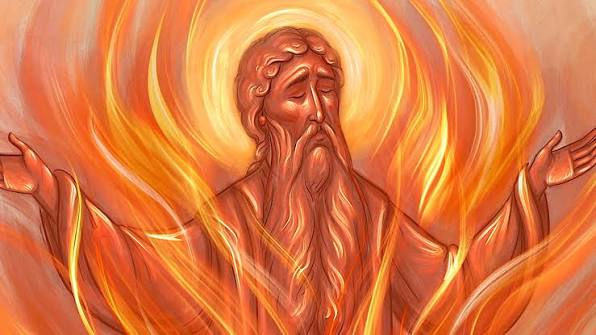
It is to allow the fire to burn away the image you have carefully curated. The priest. The monk. The teacher. The penitent. The failure. The success. All of it must be placed into the furnace. “Our God is a consuming fire.” Hebrews 12:29.
The false self fears this fire because it cannot survive it.
The true self is born in it.
St John Climacus says that love is the exile of every contrary thought. When love reigns the mind no longer circles around its own narrative. It rests. It gazes. It becomes simple.
Simplicity is terrifying. There is nothing to hide behind.
To abide in Divine Eros is to accept that you are wanted.
Not for your usefulness. Not for your eloquence. Not for your tears. You are wanted because He is Love. 1 John 4:8.
This love is not sentimental. It is crucified. It stretches out its arms and says Father forgive them. Luke 23:34. It descends into hell to seek Adam hiding in the dark. St Ephrem sings of Christ seeking Adam as a shepherd seeks a lost sheep. He knocks at the doors of death.
And you think He will not seek you in the corridors of your shame.
Abiding means surrender. It means allowing yourself to be found.
The fathers speak of apatheia not as cold detachment but as freedom from the tyranny of the passions. At the heart of the passions is self preoccupation. Fear of losing control. Fear of losing image. Fear of being nothing. Divine love casts out fear. 1 John 4:18.
When fear is cast out the soul begins to move freely toward God.
No longer calculating. No longer bargaining. No longer trying to secure a place. It rests in the One who has already prepared a place. John 14:2.
This is raw. Because it means you must relinquish the story you have told about yourself. Even the story of being the one who is broken beyond repair. Even the story of being the one who has sacrificed so much. All of it must be surrendered.
“Whoever loses his life for My sake will find it.” Matthew 16:25.
The desert is merciless in this regard. It strips you. It leaves you with no audience. No affirmation. No role to perform. There in the silence you discover that you are loved without the scaffolding.
At first it feels like death.
In truth it is resurrection.
The Lord stands at the door and knocks. Revelation 3:20. He has been knocking from the beginning. Divine Eros has been seeking you from your first breath. The compunction you feel is not condemnation. It is attraction. It is the ache of being called home.
Do not remain at the level of self accusation.
Lift your head.
Let Him love you.
Abide.


Comments