_edited.jpg)
A Heart That Can Be Wounded
The Desert and the Mercy of Becoming Flesh Again

“I will take out of your flesh the heart of stone and give you a heart of flesh.”
— Ezekiel 36:26
There is something almost frightening in the promise God makes through Ezekiel.
He does not promise merely to forgive us. He does not promise to make our circumstances easier, to resolve the uncertainties of our lives, or even to make us more religious. He promises something far more radical:
I will give you another heart.
The Fathers understood that the great tragedy of sin is not simply that we do wrong things. It is that the heart gradually becomes incapable of receiving God. We become hardened. Distracted. Self-protective. We begin living from thoughts, fears, memories, injuries, ambitions, plans, and imagined futures rather than from communion with Him.
And perhaps most dangerously, we can do this while remaining outwardly religious.
We can pray with a heart of stone.
We can fast with a heart of stone.
We can preach, teach, write, serve, build ministries, defend the Church, pursue vocations, and even seek holiness with a heart that has quietly ceased to be vulnerable to God.
This is why the desert is so severe.
The desert does not exist primarily to make strong men and women. It exists to expose the heart.
When the distractions are removed, when the consolations disappear, when our plans fail, when the identities by which we understood ourselves begin to loosen their grip, something painful happens: we discover how much of our life has been constructed around things other than God.
Even holy things.
Even service.
Even ministry.
Even our understanding of what our vocation was supposed to become.
The desert strips these things away not because they are necessarily evil, but because nothing may become the place where only God belongs.
This is the meaning of Ezekiel’s extraordinary promise:
“From all your idols I will cleanse you.”
We tend to imagine idols as obvious things—wealth, pleasure, power, possessions.
The Fathers knew better.
An idol is anything to which the heart secretly says:
Without this, I cannot live.
It may be reputation.
It may be usefulness.
It may be belonging.
It may be recognition.
It may be ecclesial security.
It may even be the particular form we believe our service to God must take.
And therefore God’s mercy sometimes comes to us in a form we initially experience as loss.
He allows what we leaned upon to become uncertain.
He permits doors to close.
He allows relationships to change.
He permits our plans to unravel.
He leads us into circumstances where we can no longer manufacture a future for ourselves.
And there, beneath all the questions, one question remains:
Is God enough?
The desert fathers fled into places where that question could no longer be avoided.
The cell became the place where every substitute was slowly exposed.
Abba Moses could not hide from Moses.
Abba Anthony could not escape Anthony.
The monk discovered that the real desert was not outside him.
It was the heart.
And there God waited.
Not to destroy the heart.
To make it flesh again.
This is one of the paradoxes of the spiritual life. We often imagine holiness as becoming invulnerable. Yet the saints become extraordinarily vulnerable.
The heart of stone cannot be wounded because it has already closed itself.
The heart of flesh can suffer.
It can grieve.
It can long.
It can repent.
It can weep.
It can be pierced by the suffering of another.
And above all, it can receive God.
Saint Isaac the Syrian understood this perhaps more beautifully than anyone. The purified heart does not become indifferent to creation. It becomes so tender that it burns with compassion for everything that exists.
This tenderness is not weakness.
It is the likeness of God.
The world teaches us to survive by hardening ourselves. Injury teaches us to protect ourselves. Disappointment teaches us to expect less. Ecclesial wounds can tempt us toward bitterness. Repeated uncertainty can make us want to seize control of our future simply so that we no longer have to endure the vulnerability of waiting.
But God says:
Give Me the stone.
Give Me the part of you that has learned to protect itself from disappointment.
Give Me the future you keep trying to arrange.
Give Me the explanation you believe you must possess.
Give Me even the image you have constructed of what faithfulness should look like.
I will give you something else.
A heart of flesh.
This is why the modern elders continually return us to repentance, stillness, watchfulness, and the remembrance of God.
Saint Silouan does not teach us how to escape suffering but how to remain with Christ within it.
Saint Sophrony does not offer a spiritual technique for constructing a secure life. He leads us toward the terrible vulnerability of standing before God with the whole of our being.
Saint Porphyrios continually draws the gaze away from obsessive struggle with darkness and toward love for Christ.
And the elders who teach the Jesus Prayer give us perhaps the simplest expression of Ezekiel’s promise:
Remain with the Name until the heart becomes alive again.
Lord Jesus Christ, Son of God, have mercy on me.
Again.
Again.
Again.
Not as magic.
Not as spiritual achievement.
Not as a method of acquiring extraordinary experiences.
But as consent.
Each repetition becomes a small surrender of the heart.
You are God.
I am not.
You are here.
I do not need to understand.
You know the way.
I will remain.
This is hesychia at its deepest.
Not merely silence around us.
The silencing of that restless interior machinery by which we are continually trying to become our own providence.
We plan.
We anticipate.
We rehearse conversations.
We imagine catastrophes.
We construct futures.
We defend identities.
We ask what will become of us.
And beneath all of this agitation God quietly says:
“I will put my Spirit within you.”
Perhaps this is the part of Ezekiel’s prophecy we most easily overlook.
God does not simply remove something.
He gives Himself.
Christian asceticism therefore cannot finally be understood as renunciation alone. The monk gives things up because Someone infinitely more beautiful has drawn near.
The desert is not emptiness.
It is encounter.
Stillness is not withdrawal into nothingness.
It is making room for the One Thing Necessary.
Hiddenness is not disappearance.
It is consenting to be seen by God without demanding to be seen by the world.
And repentance is not endless self-condemnation.
It is allowing the Spirit to break open whatever has become closed to Love.
This may be why some seasons of life become increasingly narrow.
The world becomes smaller.
The ambitions diminish.
The need to explain oneself weakens.
The desire to accomplish something impressive for God begins to feel strangely foreign.
Prayer becomes simpler.
Silence becomes more necessary.
The Name becomes sweeter.
And the heart begins to understand something the mind resisted for years:
Perhaps God was never asking us to construct a life for Him.
Perhaps He was asking us to let Him give us His life.
“I will sprinkle.”
“I will cleanse.”
“I will give.”
“I will put.”
“I will take away.”
“I will give.”
“I will put my Spirit within you.”
Notice who acts.
God.
This is the grammar of grace.
Our great ascetical labor is therefore not to manufacture transformation but to stop fleeing the hands of the One who alone can transform us.
Stay in the cell.
Remain in prayer.
Guard the heart.
Repent.
Do not run after every thought.
Do not demand to know the future.
Do not make an idol even of the form your vocation must take.
Let God be God.
This is difficult because the heart of stone often feels safer than the heart of flesh.
Stone does not have to trust.
Stone does not have to wait.
Stone does not have to love.
Stone cannot be pierced.
But neither can stone burn.
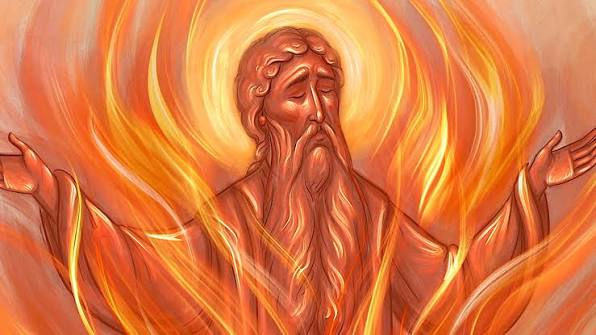
And the entire Christian life is ordered toward that mysterious moment spoken of by Abba Joseph when he raised his hands toward heaven and his fingers became like lamps of fire:
“If you will, you can become all flame.”
But first the stone must go.
The heart must become flesh again.
Tender enough to repent.
Tender enough to suffer.
Tender enough to wait.
Tender enough to love without possessing.
Tender enough to remain when there is no answer.
Tender enough to whisper the Name in the darkness without knowing what tomorrow will bring.
Perhaps this is what God has been doing all along.
Not giving us the life we imagined.
Giving us a heart capable of receiving Him.
And perhaps, in the end, that is salvation:
the stone removed,
the idols gone,
the noise quieted,
the Spirit dwelling within,
and the heart at last becoming what it was created to be—
a place where God can rest.


Comments