_edited.jpg)
When the Heart Dances Before God
Recovering Holy Wonder Before the Presence of the Lord

“David danced before the LORD with all his might.”
— 2 Samuel 6:14
The Desert Fathers would tell us that the greatest tragedy of the spiritual life is not simply that we fall into sin, but that we lose our capacity for wonder. The heart grows accustomed to holy things. We handle mysteries as though they were ordinary. We speak the Name of Christ without trembling. We stand before the Holy Mysteries with distracted minds. We pray by habit rather than by desire. Slowly, almost imperceptibly, the fire cools.
David reveals another way.
The Ark of the Covenant was not merely a religious object. It was the sign of God’s dwelling among His people. Before it, David forgot himself. He forgot his dignity, his reputation, his royal office. There remained only one overwhelming reality: the Lord had drawn near.
This is the heart of every authentic spiritual life.
The Fathers would say that repentance is not merely sorrow over sin; it is the recovery of amazement. It is awakening to the staggering truth that the living God desires communion with us. Every tear, every prostration, every whispered prayer is born from this astonishment.
Yet the narrative immediately warns us that holy desire can never be separated from holy reverence.
Uzzah reached out to steady the Ark when the oxen stumbled. His action appears reasonable, even compassionate. Yet the Fathers would urge us to look more deeply. The danger was not simply the touch of a hand, but the subtle presumption hidden within the heart. We often imagine that God depends upon us, that His work requires our anxious control, that our plans, our cleverness, or our frantic efforts are what preserve His presence in the world.
How often we do the same.
We become anxious when prayer feels dry and attempt to manufacture consolation. We interfere in another’s conversion because we cannot bear to wait upon God’s timing. We grasp at spiritual experiences instead of receiving them as gift. We seek to steady what belongs entirely to the Lord.
Saint Isaac the Syrian repeatedly reminds us that humility never grasps. Love waits. Faith consents. The heart learns to stand before God with empty hands.
David himself must learn this lesson.
His first response is anger, then fear. “How can the ark of the Lord come to me?” That question echoes throughout the whole spiritual tradition. It is the cry of every soul that begins to perceive the holiness of God. It is the same astonishment heard in the words of Saint Peter: “Depart from me, Lord, for I am a sinful man.” It is echoed by the Mother of God: “How can this be?” It reaches its fulfillment in the words of the priest before Communion: “I believe, O Lord, and I confess…”
The saints never lose this holy fear. It is not terror but awe. It is love standing before infinite Beauty.
Only after David has learned reverence does his joy become complete.
Now the Ark is carried as God commanded. Every few steps sacrifice is offered. Every movement is surrounded by thanksgiving. David dances—not because he has forgotten God’s majesty, but because he has remembered it.
This is not emotional excitement. It is freedom.
The Desert Fathers often appeared outwardly severe, yet beneath their silence burned immense joy. Elder Aimilianos once observed that when a man discovers God, everything within him begins to sing, even if no sound is heard. Saint Seraphim greeted everyone with the words, “My joy!” because he had become a dwelling place of the Holy Spirit. Their hearts danced even while their bodies remained still.
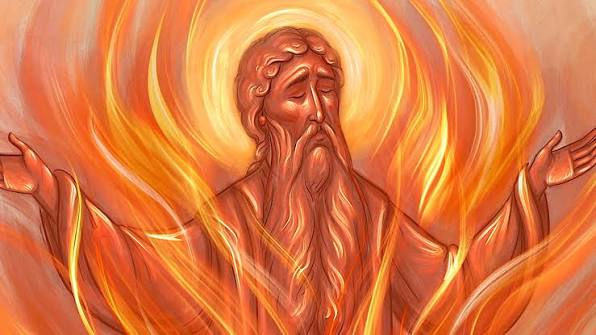
David’s dancing becomes an icon of the liberated heart.
Such freedom, however, almost always appears foolish to the world.
Michal watches from her window and despises him.
She represents something every ascetic eventually encounters—not merely criticism from others but the cold voice that arises within ourselves. It tells us to remain respectable, moderate, emotionally guarded. Do not love God too much. Do not pray too long. Do not weep. Do not become too simple. Preserve your image. Maintain control.
This voice has no understanding of love.
David’s answer is one every Christian must eventually make his own: “I will make myself yet more contemptible than this.”
The saints have always preferred to appear foolish before the world rather than wise before themselves.
Perhaps this is one of the greatest signs that we have begun to love God: we become less concerned with protecting our reputation than with offering Him our whole heart.
The modern elders often speak of acquiring a “childlike heart.” Not childish, but childlike. A heart that is capable of astonishment. A heart that still marvels at sunrise, at forgiveness, at the Eucharist, at the quiet repetition of the Name of Jesus. A heart that can still rejoice simply because Christ is near.
The greatest poverty of our age is not that we possess too little. It is that we marvel too little.
We have analyzed mystery until we no longer adore it.
We have explained grace until we rarely fall to our knees.
We have become so accustomed to God’s gifts that we scarcely notice the Giver.
The Christian life is the slow return of wonder.
Each day Christ draws near more intimately than the Ark ever entered Jerusalem. He comes not to dwell beneath curtains or upon cherubim but within the sanctuary of the human heart. If only we perceived this even for a moment, every prayer would become thanksgiving, every breath would become praise, every act of love would become a dance before the Lord.
May we never become so dignified that we can no longer rejoice before Him.
May we never become so familiar with holy things that they cease to fill us with awe.
May we become small enough, simple enough, and free enough that, whether anyone understands us or not, our whole life quietly proclaims with David:
“I will make merry before the Lord.”


Comments