_edited.jpg)
When Providence Sounds Like a Platitude
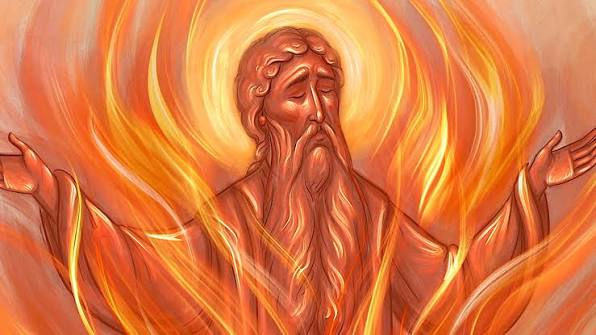
Speaking of Christ in the Furnace Without Lying About the Fire

“In the day of my trouble I sought the Lord.” - Psalm 77:2
There is a way of speaking about God’s providence that feels like a hand pressed too quickly over a wound.
“God has a plan.”
“It’s all for the best.”
“He won’t give you more than you can handle.”
To a person whose body is breaking down, whose future has narrowed to medical appointments and fatigue, whose friendships have thinned because suffering makes others uncomfortable; those words can feel less like comfort and more like abandonment wrapped in piety.
The Desert Fathers would not have spoken that way.
The Fathers Did Not Deny the Fire
If you read Isaac the Syrian, he does not romanticize affliction. He says plainly that the heart is crushed, that the soul passes through desolation, that the mind is darkened. He does not rush to tidy explanations. He speaks of tears, bewilderment, and the stripping away of false supports.
The early desert monks did not tell the suffering brother, “This is God’s will” in a tone that silenced lament. They sat with him. They wept. They reminded him that Christ Himself cried out, “My God, my God, why have You forsaken Me?”
They did not explain away Golgotha.
And the modern elders, men like Sophrony Sakharov, speak of descending into hell with Christ. Not as metaphor. As experience. As a real participation in abandonment, in humiliation, in the loss of every human support. Elder Sophrony never told a suffering soul that the pain was small. He said instead that Christ meets us at the lowest point, beneath the point where language still works.
The Temptation to Theologize Someone Else’s Cross
There is something subtly violent about interpreting another person’s suffering for them.
When illness turns a life upside down, when the body no longer obeys, when plans dissolve, when independence evaporates, something dies. Not just health. Identity. Future. Self-understanding.
To say quickly, “God is using this,” can feel like sanctifying the destruction without acknowledging the grief.
The Fathers knew that grief must be honored. They did not call darkness light.
Abba Macarius did not stand over the suffering and say, “Rejoice.” He said, “Sit in your cell and your cell will teach you everything.” And sometimes what the cell teaches first is that you are afraid. That you are angry. That you feel forgotten.
We must allow people to say that without correcting them.
Christ Is Not an Explanation
Here is the hard truth: Christ is not an explanation for suffering.
He is the One who suffers.
He does not stand outside illness offering commentary. He enters it. He does not promise that every disease will resolve, that every dream will be restored, that every loss will be reversed in this life.
The Cross is not a temporary inconvenience on the way to visible success. It is real loss. Real humiliation. Real loneliness.
When we speak to the sick, the isolated, the one whose life has collapsed, we must speak as those who know that collapse. Or at least as those who are willing to stand silently beside it.
Sometimes the most truthful words are:
“This is terribly hard.”
“I do not understand why this has happened.”
“I am here.”
And only then, gently:
“Christ is here too.”
Not False Hope — But Deeper Hope
False hope says:
“It will all go back to the way it was.”
The Gospel never says that.
True hope says:
“Even if it does not go back, even if nothing is restored outwardly, you are not abandoned.”
The Fathers speak of a hope that is born precisely when earthly securities fail. Not because the failure is good, but because the stripping reveals something indestructible — the presence of Christ in the depths.
But this cannot be imposed from the outside.
Hope that is preached too soon becomes cruelty.
Hope that rises slowly within the suffering heart, that is grace.
How Then Do We Speak?
We speak with restraint.
We speak after listening.
We speak as fellow beggars, not interpreters of God’s secret designs.
We refuse to use providence to protect ourselves from another person’s pain.
We do not promise healing that may not come.
We do not promise restoration of dreams that may remain buried.
We do not promise clarity.
We promise presence.
And if we dare to speak of Christ, we speak of Him crucified. Not triumphant in abstraction, but pierced. Thirsting. Misunderstood. Seemingly alone.
The Fathers knew something we often forget:
The deepest ministry is not explanation; it is co-suffering love.
To say, with tears rather than certainty:
“I cannot take this from you. But I will not leave you alone in it.”
That is closer to the language of the desert than polished assurances about providence.
Because providence, in the end, is not a script we decode.
It is Christ standing in the furnace and refusing to step out without us.


This is wonderful. I shared it with someone who said “Now I understand why it bugs me so much when someone tells me to “offer it up!”
Father, beautiful reflection….i just sent to my friend who recently lost her husband…..I think it will help!
Janine