_edited.jpg)
The Physician of Attention
How St. Isaac Heals the Scattered Heart Before He Teaches It to Pray
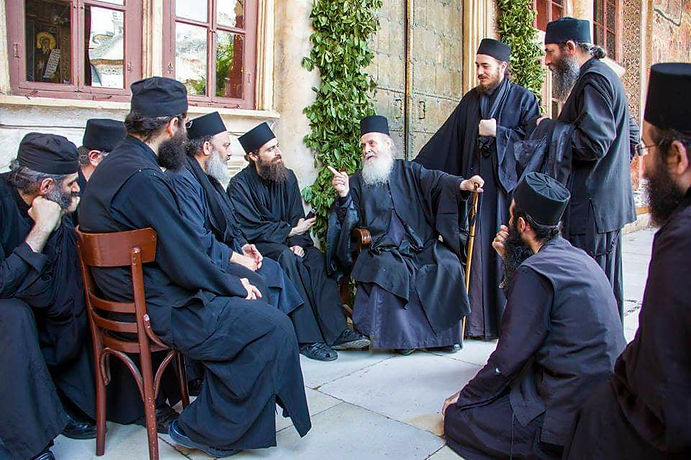
“This is the rule of life that is chaste and pleasing to God…”
— Isaac the Syrian, Homily 17
Synopsis of Tonight’s Group on The Ascetical Homilies of St. Isaac the Syrian Homily 17 paragraphs 1-4
This passage can easily be misunderstood as a catalogue of monastic etiquette or a list of ancient customs that no longer matter. Yet St. Isaac is doing something far deeper. As we noted earlier, he is acting first as a physician of attention before he becomes a teacher of prayer. He knows that the human heart cannot be united to God while it remains scattered among a thousand impulses. Every small discipline he prescribes is ordered toward healing the fragmentation of the soul.
The remarkable thing is that Isaac never begins with mystical experience. He begins with the eyes.
Our fall almost always begins with a glance.
The Fathers understood that attention is the doorway through which everything enters the heart. Before lust there is an undisciplined gaze. Before envy there is comparison. Before anger there is the unnoticed conversation rehearsed within the mind. Before pride there is the subtle desire to place ourselves at the center of every room. Isaac therefore seeks to reclaim the very movements that most people consider insignificant. He knows there are no insignificant movements. The Kingdom is lost and found in such moments.
Notice how often he speaks of restraint: not looking everywhere, not speaking unnecessarily, not choosing preferred foods, not exposing oneself, not examining another’s belongings, not rushing ahead, not interrupting, not insisting on one’s own place. At first glance this seems restrictive. In reality it is profoundly liberating.
Modern people often imagine freedom to consist in following every inclination. Isaac understands that such a life eventually becomes slavery. Every impulse obeyed strengthens the tyranny of the passions. Every impulse gently offered back to God enlarges the heart’s freedom. The monk is not learning how to suppress himself but how to cease being ruled by himself.
This explains why Isaac’s concern extends even to walking, sitting, coughing, opening a door, or entering another’s cell. None of these actions is morally significant in itself. Rather, each reveals whether the heart has become peaceful or remains agitated. A hurried body often reveals a hurried soul. A wandering eye often reveals a wandering mind. Carelessness in little things usually uncovers carelessness before God.
His teaching also protects something we have almost forgotten: reverence for persons.
He tells the monk not to inspect another’s cell, not to notice where possessions are kept, not to stare into another’s face, not to become overly familiar, to wait patiently while a companion speaks, and to regard oneself as the servant of all. These are not merely rules of courtesy. They preserve the mystery of the other person. They refuse to reduce another to an object of curiosity, judgment, or possession.
How much suffering enters the world because we cannot leave another person untouched by our curiosity? How many relationships are damaged because we feel entitled to know, to inspect, to analyze, to possess? Isaac trains the monk to stand before another with the same reverence with which he stands before the sanctuary.
The humility he seeks is therefore not psychological self-deprecation but freedom from self-preoccupation. The one who always considers himself the servant no longer needs to defend his dignity, compete for recognition, or insist upon preference. His attention has quietly shifted away from himself.
Perhaps most striking is the hiddenness that runs through the entire passage. Nothing here seeks to attract notice. Every instruction moves the monk toward simplicity, modesty, and invisibility. One senses that Isaac wishes the monk to pass through the world without disturbing its peace. His presence should become gentle enough that others encounter not his personality but the quiet fragrance of Christ.
This is why these seemingly insignificant counsels remain astonishingly relevant. Our age is built upon distraction, display, speed, consumption, and constant exposure. Isaac proposes the opposite movement: recollection, hiddenness, moderation, silence, and attentiveness. He is not asking us to become antiquated. He is inviting us to become whole.
The physician begins with the smallest gestures because he knows they reveal the deepest illnesses. If the eye can become steady, the tongue restrained, the appetite moderate, the body reverent, and the heart humble, then attention gradually gathers itself into one place. Only then does the soul become capable of what Isaac desires above all else: to stand quietly before God with an undivided heart.
For Isaac, this is the true rule of life. Not a collection of external observances, but the slow restoration of a human being whose every movement—outward and inward—has become an expression of love. Only such a heart can pray without ceasing, because it has finally learned to live without scattering itself among countless desires.


Comments