_edited.jpg)
The Altar You Cannot Escape
You Are the Sacrifice You Keep Trying to Spare

“Present your bodies as a living sacrifice… holy and acceptable to God.”
— Epistle to the Romans 12:1
⸻
There is something in us that wants religion without sacrifice.
We want devotion that comforts but does not consume.
We want prayer that soothes but does not strip us.
We want Christ—but not the altar.
And yet Saint Peter Chrysologus does not allow this illusion to survive even a moment.
He tells us plainly:
You are the sacrifice.
Not your time.
Not your preferences.
Not your occasional generosity.
You.
We recoil at the word immolation.
It sounds cruel, excessive, even primitive.
But the truth is more unsettling:
we are already being consumed—just not by God.
We are consumed by anxiety.
By resentment.
By the need to be seen, justified, affirmed.
By the quiet demand that life go according to our will.
This is the false altar we live on.
And it is killing us slowly.
So when God calls us to become a “living sacrifice,” He is not introducing suffering into our life—
He is redeeming the suffering already there.
You do not need to go anywhere to offer sacrifice.
You do not need a temple.
You do not need a ritual space.
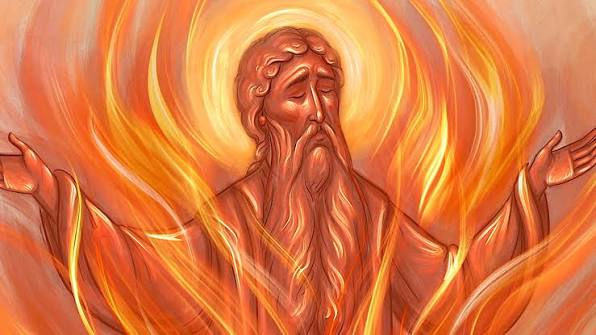
You carry the altar inside you.
Your thoughts are the fire.
Your heart is the place of offering.
Your body is the victim.
And this means there is no escape.
Every irritation becomes material for sacrifice.
Every humiliation becomes an opening.
Every moment of powerlessness becomes a place where something in you can either harden—or be offered.
We spend enormous energy trying to avoid suffering.
But the Cross reveals something unbearable to the ego:
Suffering is not the enemy.
Un-offered suffering is.
Christ does not eliminate pain—
He enters it and transforms it.
When suffering is resisted, it becomes bitterness.
When it is clutched, it becomes identity.
When it is explained away, it becomes illusion.
But when it is offered, something changes at the deepest level of the person:
It becomes communion.
We want to remain in control.
We want to offer something—but not be offered.
But the Christian mystery abolishes this distance.
You are not standing outside your life, choosing what to give to God.
Your life itself is the offering.
The moment you forgive when everything in you wants to retaliate—
the knife touches the sacrifice.
The moment you remain silent instead of defending yourself—
the offering is placed on the altar.
The moment you endure misunderstanding without collapsing into self-justification—
the fire begins to burn.
And yet—you are not destroyed.
This is the paradox Chrysologus points to:
The victim lives.
Because it feels like death.
To surrender your will.
To relinquish your need to be right.
To let go of the identity built around your wounds.
This feels like annihilation.
And in a sense, it is.
But what dies is not the self—
it is the false self that cannot love.
If you remain on this altar—quietly, without drama, without self-conscious spirituality—something begins to happen that cannot be manufactured:
Your suffering softens instead of hardening you.
Your wounds deepen your compassion instead of your defenses.
Your life becomes strangely spacious, even in limitation.
You begin to love without needing a return.
To endure without needing explanation.
To remain without needing escape.
This is not moral improvement.
This is participation in the life of Christ.
God does not want your destruction.
He wants your consent.
He does not thirst for your pain.
He waits for your offering.
And the offering He seeks is not heroic, not dramatic, not visible:
It is the quiet, daily, hidden surrender of the heart
that says, again and again:
“Take this. Even this.”
You will suffer.
That is not optional.
But what your suffering becomes—that is where your freedom lies.
You can let it close you,
define you,
embitter you—
or
you can place it on the altar within you
and allow it to be taken up into something eternal.
And if you do—
you will discover, slowly and without spectacle,
that the Cross was never meant to crush you.
It was meant to make you capable of love.


Lord, create an altar within me. In all I think, say and do. The crosses and the joys. Let me offer everything to You.