_edited.jpg)
Beyond Analysis
Where the Religious Self Dies and Christ Becomes Life

“I live, yet not I, but Christ lives in me.”
Galatians 2:20
There was a time when I believed that if one went deeply enough into the self, if one endured the long work of analysis with honesty and courage, then something essential would be uncovered and healed.
And to a certain extent, this is true.
Analysis demands a kind of truthfulness that many never approach. It exposes the hidden movements of the heart. It reveals the patterns, the defenses, the wounds that shape perception and relationships. It strips away illusions that one did not even know were there. It can feel like a kind of death when the narratives that once held everything together begin to fall apart.
But even at its deepest, it remains within a boundary.
It clarifies the self.
It does not transcend it.
What I encountered in the spiritual life, as it is revealed by the Fathers and confirmed in my own experience, was something altogether different. Not deeper in degree, but different in kind.
It was not a process I could guide.
It was not something I could understand.
It was not even something I could cooperate with in the way one cooperates in analysis.
It was something I had to endure.
God does not analyze the soul.
He enters it.
And in His presence, everything begins to change in a way that is both hidden and absolute. What is false begins to fall away, not because it has been named or interpreted, but because it cannot remain in the light of His being.
This is where the real dismantling begins.
Not simply of wounds or defenses.
But of the very center from which one has lived.
The “I” that one has protected, refined, strengthened, and even spiritualized begins to lose its ground. One begins to see, often without clarity and without words, that even one’s virtues can be subtly rooted in self. Even prayer can be a form of self-preservation. Even the desire for God can be mixed with the desire to remain intact.
And God, in His mercy, does not leave this untouched.
He strips.
He silences.
He withdraws what once sustained.
Not to destroy, but to bring about something that cannot be produced by human effort.
There is a point where one no longer understands what is happening.
Prayer becomes dry.
Thought becomes unreliable.
Experience offers no foothold.
One cannot return to what was.
One cannot move forward by effort.
This is the place the Fathers speak of with such sobriety.
The place of death.
“Unless a grain of wheat falls into the earth and dies…”
This is not an image.
It is a reality.
Something in the soul begins to collapse.
Not dramatically.
Not in a way that can be narrated.
Quietly.
Persistently.
And often with great confusion.
What once gave identity begins to dissolve. The structures that organized one’s inner life no longer hold. Even the sense of oneself as a “religious” person, as one who understands, as one who has something to offer, begins to disappear.
And there is nothing to replace it.
At least not in a way that can be grasped.
This is where analysis cannot follow.
Because there is nothing to interpret.
Only something to endure.
And yet, hidden within this dismantling is a mystery that only reveals itself slowly.
The One who strips away is not absent.
He is nearer than ever.
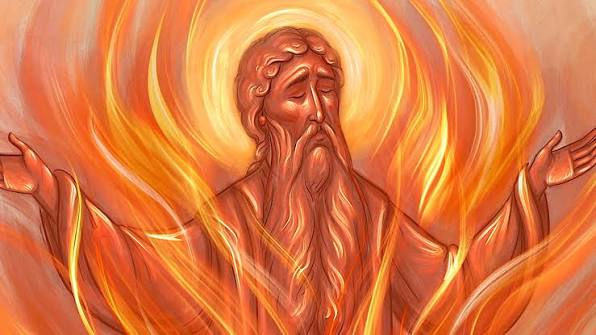
But His nearness is no longer felt in a way that reassures the self. It is a nearness that consumes. A fire that does not leave anything untouched.
“Our God is a consuming fire.”
What emerges from this is not a stronger self.
Not a clearer identity.
Not even a more integrated personality.
What begins to emerge, if one endures and does not turn back, is a life that no longer originates from oneself.
“I live, yet not I…”
This is no longer an idea.
It becomes, in some hidden way, a reality.
One begins to live without referring everything back to the self. One begins to love without calculation. One begins to see others not through the lens of need or fear or usefulness, but in Christ.
This does not come all at once.
And it is never possessed.
It is given.
And it remains hidden even as it is lived.
This is why the Fathers speak so little about understanding and so much about humility, endurance, and repentance.
Because what is taking place cannot be grasped by the mind.
It can only be received through a heart that has been broken open.
Analysis may bring a man to honesty about himself.
Grace brings a man to the end of himself.
And there, in that place where nothing remains that can be claimed or understood, Christ begins to live.
Not as an idea.
Not as an aspiration.
But as life itself.


Comments