_edited.jpg)
Where Hell Is Faced and God Is Not Lost
On Suffering, Silence, and the Refusal to Despair

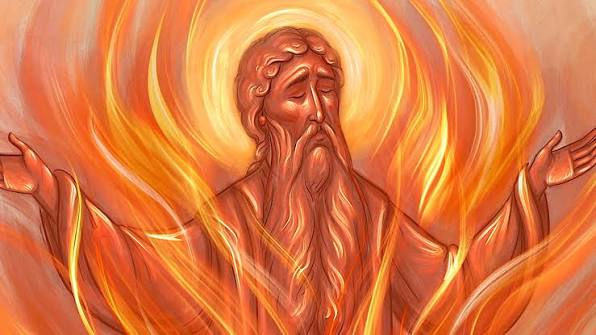
“Keep your mind in hell, and despair not.”
St. Silouan the Athonite
⸻
There are forms of suffering that do not visit a man and pass, but remain. They settle into the body, into the rhythm of the day, into the limits of what one can do and bear. Chronic illness has this character. It does not argue. It does not explain itself. It simply endures, and in enduring, it presses upon the heart with a kind of constancy that can feel indistinguishable from darkness.
Over time, this constancy begins to speak.
Not with words at first, but with suggestion. A quiet interpretation begins to form. God is silent. Nothing is changing. This is what your life is now. And from this, something more dangerous arises. Perhaps this is punishment. Perhaps this is abandonment. Perhaps God has withdrawn.
The soul does not arrive at despair suddenly. It is led there by interpretation.
And this is where the word of the Elder becomes both difficult and necessary.
“Keep your mind in hell.”
He does not say, escape it. He does not say, reinterpret your suffering so that it feels lighter. He does not offer a way out. He allows the full weight of darkness to remain. The pain, the limitation, the silence, the sense of not being answered. All of it is permitted to stand before the mind without being softened.
This is already a severe thing.
Because everything in us wants relief, not only from the suffering itself, but from its meaning. We want to understand why. We want to know what God is doing. We want to be reassured that something is happening beneath the surface. And when this reassurance does not come, we begin to supply our own conclusions.
This is where the fall takes place.
“God is silent” becomes “God is absent.”
“Suffering remains” becomes “I am being punished.”
“I do not feel Him” becomes “He is not here.”
The Elder cuts this movement at its root.
“Despair not.”
He does not remove the darkness. He removes the conclusion.
You are allowed to feel the weight of your condition. You are allowed to experience the silence. You are allowed to stand in a place that, in every human sense, resembles hell. But you are not allowed to interpret this as the absence of God.
This is the narrow path.
It is not emotional. It is not supported by consolation. It does not depend upon insight or clarity. It is a decision made in the depth of the heart, often without any reinforcement from experience.
God is not absent.
Not because you feel Him.
Not because you understand Him.
But because He is.
This is faith stripped of everything that usually sustains it.
There is a hidden violence in this teaching, but it is a violence directed not against the suffering, but against the false interpretations that arise from it. The mind wants to construct meaning. It wants to explain the darkness in a way that allows it to regain control. But the Elder refuses this entirely.
You will not control this.
You will not understand this.
You will not resolve this.
You will remain.
And in remaining, something begins to change, though not in the way one expects.
The heart is slowly separated from its need to feel, to measure, to interpret. It begins, almost imperceptibly, to hold two realities at once. On the one hand, the full weight of suffering remains. The body is still weak. The days are still long. The silence of God is still felt. Nothing external has shifted.
And yet, beneath this, something else takes root.
A refusal to abandon God.
Not a strong refusal. Not a confident one. Often a trembling one. Sometimes barely more than a turning of the will, repeated again and again without consolation. But it is real. And it is enough.
This is what the Elder protects.
Not the removal of suffering.
Not the clarity of understanding.
But the bond between the soul and God.
Chronic suffering exposes how much of our spiritual life has been supported by things we did not recognize. Energy. clarity. the ability to pray as we once did. the sense of movement. When these are taken away, prayer changes. It becomes simpler. Poorer. Often wordless. Sometimes nothing more than a silent endurance before God.
It can feel like failure.
But it may be the beginning of something truer.
For now the soul no longer comes to God with strength, or even with a sense of offering. It comes as it is. limited. exhausted. unable to produce anything that resembles what it once called prayer. And yet it comes.
Or rather, it remains.
This remaining is the place where the word of the Elder is fulfilled.
To keep the mind in hell is to refuse to turn away from the truth of one’s condition. To see one’s weakness, one’s limitation, the darkness of one’s experience, without fleeing into illusion. But to despair not is to refuse to let this truth define God.
The suffering does not reveal God’s absence.
It reveals your poverty.
And this poverty, if endured without interpretation, becomes a place of encounter.
Not an encounter that is felt or understood, but one that is real.
There is a kind of love that only emerges here. A love that does not depend upon response. A fidelity that does not depend upon reward. A turning toward God that persists even when nothing returns to meet it.
This love is hidden.
It does not appear as fervor.
It does not appear as consolation.
It often does not appear at all.
But it is known to God.
And it sustains more than you can see.
The world will not recognize this. It will see limitation, loss, inactivity. It will measure the life and find it diminished. Even the soul itself may be tempted to agree.
But the Elder speaks from another knowledge.
To remain turned toward God in the midst of darkness without concluding against Him is a work of immense value. It is a participation in the life of Christ Himself, who entered into the deepest abandonment without ceasing to entrust Himself to the Father.
This does not remove the weight of the days.
But it transfigures their meaning.
You are not being punished.
You are not being abandoned.
You are being brought to a place where love can exist without support.
And there, even in silence, even in weakness, even in what feels like hell,
God is not absent.
He is hidden.
And He remains.


Lord, I remain. Trust, reliance, support from others are gone. Let them remain gone. May I trust in You alone. Live within me.