_edited.jpg)
To Become Fire and Person
On the End of the Religious Self and the Birth of the Hypostatic Man

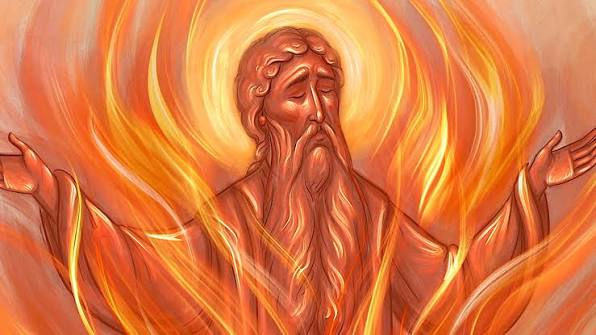
“Our God is a consuming fire.”
Hebrews 12:29
There is a vision of the spiritual life that remains small because it never allows God to be who He is.
It reduces everything to measure. To effort. To progress that can be tracked, explained, and secured. It speaks of virtue, but only in ways that preserve the one who practices it. It speaks of God, but only in ways that can be contained by thought.
This is the religion of the self.
It may be moral. It may be disciplined. It may even appear devout. But it remains untouched by fire.
Because the God who reveals Himself in the Fathers is not an idea, not a system, not an impersonal absolute. He is personal, living, and free. He is not something we approach in order to become better versions of ourselves. He is the One who calls us out of ourselves entirely.
He is a consuming fire.
And this fire does not perfect the religious ego. It destroys it.
Not because the self is evil, but because what we have constructed in place of the true self cannot endure His presence. We have fashioned identities in the name of faith. We have imagined what it means to be in His image and likeness. We have tried to become something recognizable, stable, and secure.
But God did not create an image for us to imitate.
He created a person to be united to Him.
“In creating man, God has repeated Himself in His creature.”
This cannot be grasped by the religious mind. It is too great. It means that the purpose of our existence is not moral improvement, but union. Not conformity to an external law, but participation in His very life. Not becoming religious, but becoming by grace what He is by nature.
To become fire is to enter this mystery.
It is to allow God to burn away not only sin, but every false image we have made of ourselves in His name. It is to relinquish the need to define, to secure, to establish an identity apart from Him. It is to stand before the living God without form, without claim, without possession—even of our own supposed holiness.
This feels like death.
Because everything we have relied upon begins to dissolve. The structures of thought. The frameworks of certainty. The subtle assurance that we know what we are doing, where we are going, who we are before God.
All of it is shaken.
And yet, what is revealed is not nothingness, but personhood.
Not the isolated individual, enclosed within himself, but the hypostasis that bears within it the whole of creation. The man who, by grace, becomes capable of containing others, loving others, interceding for others—not as an effort, but as the very content of his being.
“Man is perfected… when by His grace, all humanity becomes the content of his existence.”
This is the end of the religious self.
Because the religious ego is always concerned with itself—its progress, its purity, its standing, its understanding. Even its humility can become a possession. Even its repentance can become a subtle form of self-regard.
But the man who has been touched by fire no longer lives in reference to himself.
He becomes an event.
His life is no longer a project, but a meeting. A meeting between God and man, renewed in every moment, sustained not by effort but by grace. God reveals Himself, and man responds in freedom—not by constructing himself, but by offering himself.
This is deification.
Not an exaltation of the individual, but the end of individualism. Not absorption into an impersonal absolute, but communion with the living God who remains other, who remains free, who remains love.
Outside of this communion, everything dissolves.
Even man, if he lives apart from God, becomes like water without form—dispersed, evaporated, unable to hold anything, unable to endure. The tragedy of our age is not that it rejects religion, but that it has replaced personhood with abstraction and communion with isolation.
And so the call remains.
Why not become all fire?
Why not allow the consuming God to strip away everything that is not capable of bearing His life?
Why not relinquish the false, so that the true may be revealed?
Few accept this path. Because it offers nothing that can be possessed. Nothing that can be secured. Nothing that can be used to define oneself.
It offers only God.
And yet, in receiving Him, man becomes what he was created to be.
Not a religious man.
But a living person, radiant with grace, bearing within himself the life of the world, and standing before God as one of His own.
_______
The Above Reflection Was Written in Light of:
Archimandrite Zacharias Zacharou
Hypostatic Prayer pp 106-107


This would be a good post to reflect upon and pray about in anticipation of the upcoming Pentecost retreat and in light of our recent Lenten retreat on the dismantling of the religious ego. God in his everlasting love draws us into something beyond our imagination.