_edited.jpg)
The Apostle Who Chose the Desert of a Nation
St. Patrick and the Hidden Ascesis of Love

“Christ with me, Christ before me, Christ behind me…” — St. Patrick
He was not formed in a monastery.
He was taken.
St. Patrick did not go into the desert by choice at first. He was dragged there as a slave, torn from comfort, stripped of identity, cast into a foreign land where no one knew his name and no one cared to learn it. The desert came to him in the form of humiliation, isolation, and obscurity.
And there, in that involuntary exile, something began.
He writes simply that he prayed.
Again and again.
Through cold and hunger.
Through long nights and empty hills.
The man who had once been careless became a man seized by God.
This is the beginning of asceticism.
Not the choosing of hardship as an achievement, but the acceptance of it as a place of encounter.
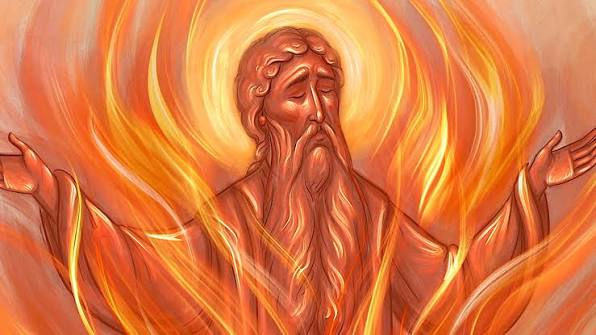
Patrick did not seek visions. He did not construct a system. He endured. And in enduring, his heart was broken open. Prayer ceased to be an obligation and became breath itself. The remembrance of God took root in him not as an idea, but as a fire that would not leave him.
The desert had entered his heart.
When he finally escaped, he did not flee the desert. He carried it within him.
And then came the greater ascesis.
He returned.
Not to a monastery of silence, but to the very land of his captivity. Not to men who would honor him, but to those who had enslaved him. He chose to go back, not as a victim, but as an offering.
This is the deeper fast.
To renounce not only comfort, but resentment.
To relinquish not only possessions, but the right to be justified.
To love those who wounded you, not in word, but in presence.
Patrick’s mission was not merely apostolic. It was cruciform.
He entered Ireland as a man already emptied. The years of hidden struggle had stripped him of the need to be seen, to be praised, to succeed. He came without power, without protection, without guarantees.
And yet, he bore within himself a kingdom.
The ascetic does not conquer the world by force. He transfigures it by the life he carries.
Patrick’s authority came from the desert within him. His words had weight because they were born of silence. His endurance gave credibility to his preaching. He did not speak about Christ as one repeating a message. He spoke as one who had been seized, broken, and remade.
This is why the land listened.
Not because he was eloquent.
Not because he was strategic.
But because he had died before he came.
There is a temptation to see asceticism as withdrawal.
Patrick reveals something more terrible and more beautiful.
The true ascetic is not simply one who leaves the world, but one who is no longer bound by it. He can be sent anywhere, endure anything, love without measure, because nothing remains in him that demands to be preserved.
He has already lost his life.
And so he can give it.
Patrick’s Ireland became a kind of desert flowering. Monks would later go into the wild places, into the sea, into the unknown, carrying forward that same spirit: exile for the sake of Christ, prayer without ceasing, a heart stretched wide enough to hold a people.
But it began with a man alone on a hillside.
Cold.
Forgotten.
Praying.
The ascetic is not made in public.
He is formed where no one sees him, where his only companion is God, and his only work is to remain faithful in the face of emptiness.
Patrick did not set out to become a saint.
He became a man who remembered God when everything else was taken from him.
And from that remembrance, a nation was reborn.


Thank you, Father - a beautiful tribute to one of the great Lights of the Western Church and one of my lifelong favourite Saints.