_edited.jpg)
When There Are No Fathers
On the silent catastrophe of a Church without elders

“Ask your father, and he will show you; your elders, and they will tell you.”
Deuteronomy 32:7
⸻
There is a wound in the Church that few speak of openly.
It is not doctrinal.
It is not liturgical.
It is not moral in the way people usually mean.
It is paternal.
There are not enough fathers.
Not priests. Not administrators. Not scholars. Fathers.
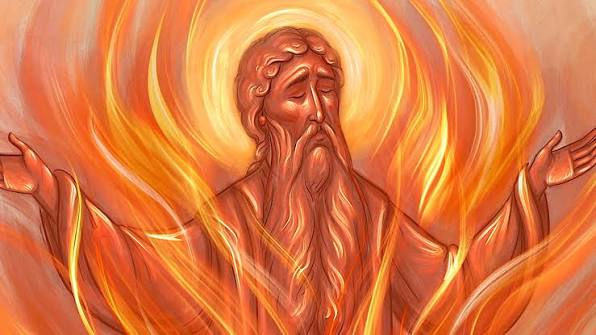
Men and women who have passed through the fire and emerged without illusion. Souls who have stood long enough before God that their words no longer come from opinion but from participation. People who no longer speak to influence but because silence itself has become luminous and their words emerge from necessity rather than compulsion.
These have become rare.
And the consequences are everywhere.
⸻
In the early centuries, a Christian did not navigate the spiritual life alone. This would have been considered unthinkable. Dangerous. Even prideful.
A monk would travel across deserts to sit at the feet of an elder for a single sentence. Not because the elder possessed information. But because he possessed vision. He could see what the younger man could not see in himself. He could detect illusion where the struggler saw only sincerity. He could recognize grace where the struggler saw only failure.
Without such fathers, the spiritual life becomes guesswork.
A man reads texts but does not know how to apply them. He undertakes ascetic efforts but cannot discern whether they are born of grace or ego. He mistakes psychological wounds for spiritual warfare. He mistakes emotional intensity for repentance. He mistakes exhaustion for sacrifice.
And there is no one to correct him.
So he labors beyond his strength. Or he withdraws prematurely. Or he builds an identity around spiritual effort that quietly strengthens the very self he believes he is crucifying.
This is how distortion enters quietly.
Not through rebellion. Through isolation.
⸻
The tragedy is not that elders have disappeared entirely.
The tragedy is that they have become inaccessible.
Monasteries once stood as places where one could encounter a different kind of human being. Even a brief visit could recalibrate the soul. One saw a face that was not restless. One heard words that were not hurried. One encountered a presence that did not need anything from you.
This alone could heal something invisible.
But monasteries have become fewer. And even where they exist, the number of truly formed elders is small. Formation takes decades. It cannot be manufactured. It cannot be accelerated. It cannot be conferred by position or education.
It emerges through hidden suffering, obedience, stability, and grace.
Without such places, Christians are left to navigate the most dangerous terrain alone. Their own hearts.
And the heart is not a safe guide when it has not yet been purified.
⸻
The long term effects are already visible.
Christians become dependent on books but lack discernment. They accumulate teachings but lack transformation. They become articulate about prayer but do not pray. Or they pray intensely but without guidance and fall into despair when dryness inevitably comes.
Some become rigid, clinging to external forms because no one has taught them the inner life those forms were meant to protect.
Others abandon the struggle entirely, concluding that the promises of the spiritual life were exaggerated because they never encountered someone in whom those promises had been fulfilled.
Worst of all, some unconsciously assume the role of teacher without having first been fathered. They pass on what they have read but not what they have become.
This perpetuates the wound across generations.
The Church retains structure but loses transmission.
The form remains. The life thins.
⸻
An elder does not primarily give answers.
He gives reality.
His presence exposes illusion without violence. His words carry authority because they are born from obedience, not autonomy. He does not need disciples. He does not need recognition. He often resists both.
He has died enough to himself that others can safely live in his presence.
Without such men and women, Christians are left vulnerable to two equal and opposite dangers.
Self-reliance.
And dependency on structures that cannot replace personal spiritual fatherhood.
Neither can sustain the soul long term.
⸻
This absence creates a quiet loneliness in the Church that many carry without naming.
They search for decades. They read. They pray. They seek counsel where they can. But they know inwardly that something essential is missing. Not information. Not sincerity. But covering.
Someone who sees them fully and is not afraid.
Someone who can say, with authority born of having passed through the same fire, this way leads to life and this way leads to illusion.
This kind of authority cannot be improvised.
It must be inherited.
And inheritance requires fathers.
⸻
Yet even here, hope remains.
Because God has never abandoned His Church.
Even in times of scarcity, He preserves hidden ones. Unknown. Unrecognized. Sometimes in monasteries. Sometimes in parishes. Sometimes in places no one expects.
And even when no visible elder is present, the hunger itself becomes formative.
The one who seeks sincerely, who refuses self-deception, who prays for guidance without demanding control, is not abandoned.
God Himself becomes their teacher through circumstances, suffering, and grace.
This is not the ordinary way. But it is a real one.
Still, the Church must reckon honestly with this loss.
Not with accusation. But with sobriety.
Because the future of the Church does not depend primarily on programs, arguments, or expansion.
It depends on the quiet emergence of men and women who have learned, through long obedience and suffering, how to stand before God without illusion.
Fathers.
Without them, the Church survives.
With them, the Church lives.


Comments