_edited.jpg)
When Prayer Becomes Flesh
The Only Evangelization the World Cannot Resist

“Make peace with yourself, and heaven and earth will make peace with you.”
— Isaac the Syrian
—
There is something in the words of Isaac the Syrian that unsettles us
precisely because it leaves us with nothing to hide behind.
He does not speak of strategies.
He does not speak of methods.
He does not speak of influence, reach, or effectiveness.
He speaks of a man.
A man who has become prayer.
—
This is the scandal.
Because we have built an entire vision of evangelization
that carefully avoids this.
We speak constantly about bringing Christ to the world.
But we do not become the place where Christ lives.
—
The hypostatic union is not an abstract doctrine to be defended.
It is the revelation of what humanity is meant to become.
In Jesus Christ
human nature is not improved.
It is united.
Not externally.
Not symbolically.
But in truth.
And this union is not locked in history.
It is given.
It is offered.
It is to be lived.
—
Prayer, then, is not words spoken toward God.
It is the gradual surrender of the self
into that union.
Until the “I” that prays
is no longer separate
from the life of Christ.
—
This is why the saints do not argue.
They do not need to.
Their existence becomes a word
that cannot be contradicted.
—
And this is what exposes us.
Because we rely on words
precisely where there is no reality.
We speak about love
without becoming it.
We speak about Christ
without being conformed to Him.
We speak about the Spirit
while remaining governed by fear, control, and self-protection.
—
The world sees this.
And it turns away.
Not because it rejects Christ.
But because it does not encounter Him.
—
We think the problem is that the world is hostile.
That it is secular.
That it has lost its way.
But the Fathers would say something far more severe:
The world does not believe
because it has not seen.
—
Seen what?
A human being
whose very presence
reveals another life.
—
Isaac the Syrian speaks of the heart that has become merciful.
Not selectively.
Not ideologically.
But universally.
A heart that burns for all creation.
Even for demons.
Even for those who hate.
Even for those outside the Church.
—
This is not tolerance.
This is not accommodation.
This is transformation.
—
And it is here that evangelization becomes something entirely different.
Not the transmission of ideas.
Not the defense of doctrine.
But the manifestation of a life
that cannot be explained
by anything other than God.
—
This is why the saints penetrate.
Without effort.
Without noise.
Without strategy.
They enter into the depths of others
because they have allowed God
to enter into their own depths.
—
And so they speak
without speaking.
They reveal
without argument.
They draw
without persuasion.
—
But we do not want this.
Because it requires death.
Not metaphorically.
Actually.
The death of the self that needs to be seen,
needs to be effective,
needs to be right.
—
Programs protect us from this.
Methods allow us to remain intact.
Teaching can become a shield
that hides the absence of transformation.
—
But the Gospel was never meant to be spread this way.
It spread through men and women
who had nothing left
but Christ.
—
This is the vision set before us.
And it is merciless.
Because it leaves no room for compromise.
—
We can continue to build.
To organize.
To speak.
To produce.
And perhaps even to succeed
on our own terms.
—
Or . . .
we can become
the place
where the Word is made flesh again.
—
Until that happens,
our evangelization will remain external.
And the world will remain untouched
at its depths.
—
The truth is this:
The world does not need more explanations.
It needs to encounter
a human being
in whom Christ is alive.
—
Anything less
will always feel like something is missing.
Because something is.
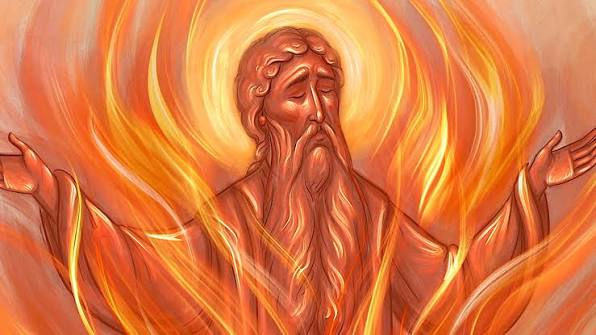


….”we can become
the place
where the Word is made flesh again.”
________
When there is nothing left on earth to hold on to—not a person, not anything—nothing to offer support, you turn to God completely. In a slow, slow but total, surrender.
There was a hollow in me. Dark. Dull. The shape of loss.
The Lord moved into it.
And made that emptiness a habitable space. For Him.
And I, looking East, where the Sun rises, have no need to analyze. No need to reason through His ways.
The East does not explain Mystery.
It enters it.
…to Remain and Receive.