_edited.jpg)
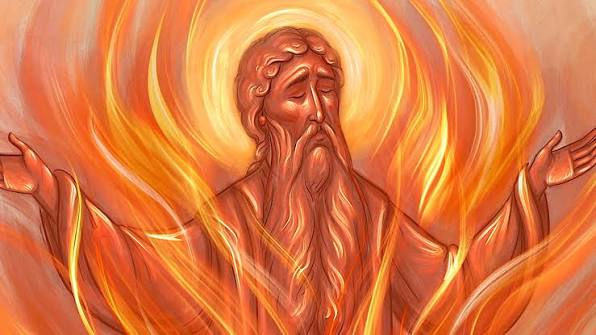
The Widow Who Saw God
St. Anna the Prophetess and the hidden life that becomes proclamation

“And she did not depart from the temple, worshiping with fasting and prayer night and day. And coming up at that very hour she gave thanks to God and spoke of Him to all who were waiting for the redemption of Jerusalem.”
— Luke 2:37–38
Anna, the daughter of Phanuel, appears in the Gospel of Luke for only a few verses, yet in those verses the whole mystery of a life lived for God is revealed. She is already eighty-four years old when the infant Christ is carried into the Temple. Her husband had died after only seven years of marriage, and from that moment her life became something the world would scarcely notice. Luke says she “did not depart from the temple, worshiping with fasting and prayer night and day” (Luke 2:37). Decades pass. No visions are recorded. No miracles. No travels. No teaching. Just a woman who remains, prays, fasts, and waits.
In the logic of the world this is a wasted life. In the logic of the Kingdom it is a life that becomes a sanctuary.
The Desert Fathers tell us again and again that what saves the soul is not brilliance or achievement but stability of heart before God. Abba Moses said that the monk’s cell teaches him everything if he stays in it. Anna’s cell was the Temple. Her obedience was to remain. Her asceticism was not dramatic but unrelenting: prayer, fasting, vigilance, presence. St Isaac the Syrian says that the one who remains in stillness before God “is a theologian without words,” because the heart itself becomes an altar. This is Anna. Her entire being had become an inner sanctuary, purified through long years of loss, silence, and longing.
We must not miss what kind of suffering lies beneath Luke’s simple words. Anna was not a woman untouched by love. She had been married. She had known intimacy, hope, shared life. And then it was taken from her. The Desert Fathers never idealize such wounds. They speak of how sorrow, when endured before God, becomes the soil of true prayer. Abba Poemen said that tears are the second baptism, because they wash the heart of all that is false. Anna’s widowhood was not merely a biographical detail. It was the furnace in which her heart was made single. Everything that could be clung to was stripped away, until only God remained.
And so she waited.
This is the hardest spiritual labor of all: to remain faithful in obscurity, without reward, without recognition, without visible fruit. St Sophrony would later say that the greatest proof of love for God is not ecstasy but endurance. To continue standing before God when nothing seems to happen, when prayer feels dry, when life seems small. Anna’s life was this endurance. Year after year she returned to the Temple. Year after year she fasted. Year after year she prayed. And slowly, invisibly, her heart was made capable of recognizing Christ when He came.
This is why Luke tells us that when she saw the Child she immediately knew. Purity of heart sees God. Christ did not reveal Himself to the clever, the powerful, or the religiously impressive. He revealed Himself to those whose hearts had been hollowed out by longing and filled by prayer. Simeon had waited in hope. Anna had waited in fasting and tears. Together they become the first witnesses of the Messiah in the Temple of Israel.
And notice what happens. Anna does not remain silent. The woman who had spent decades in hidden prayer becomes suddenly a herald. Luke says that she “spoke of Him to all who were waiting for the redemption of Jerusalem” (Luke 2:38). She becomes the first evangelist. But this proclamation is not activism. It is overflow. Her words have weight because they come from a life that has been entirely offered. St Maximos the Confessor says that true speech about God is born from purification. Anna’s fasting and prayer had made her heart truthful, so when she spoke, Christ Himself spoke through her.
Modern elders say the same thing in another voice. Archimandrite Zacharias writes that the one who remains faithful in hiddenness becomes universal in Christ. A life that looks narrow becomes, in God, spacious enough to carry the whole world. Anna’s solitude in the Temple was not isolation. It was intercession. She carried Israel in her heart. She carried the ache of the poor and the forgotten. And when Christ came, her heart was already shaped to receive Him and to announce Him.
This is the paradox of the Christian life. A life that looks empty from the outside can be burning with meaning. A woman unknown to history becomes known to heaven. A widow praying in a corner of the Temple becomes part of the Gospel itself. Anna’s name is read in every generation because she chose to remain, to pray, and to wait.
For those who live quietly, who feel that their days are small, who wonder whether anything is happening, Anna stands as a living answer. God is not impressed by noise. He is moved by fidelity. He is not looking for those who rush. He is looking for those who stay. And when He comes, He comes to those whose hearts have been made ready by long love, long sorrow, and long prayer.
Anna did not go out into the world to find Christ.
She stayed, and Christ came to her.


Comments