_edited.jpg)
The Things Hung Around the Neck
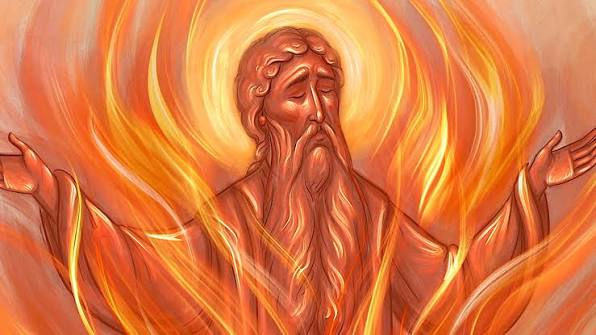
Standing Before the Image

“If you wish to be saved, become as one who is dead.
For a dead man does not judge, is not judged,
is not honored, and is not dishonored.”
Abba Makarios the Great
There is something in this story* of Abba Makarios that presses more deeply than its ending. Not the vindication. Not the confession. Not even the humility of the saint. It is the image itself that remains, severe and unforgettable. A man led through the streets with blackened pots and wooden spoons hanging around his neck.
The desert leaves them there.
The Fathers do not hurry to remove them. They allow us to look.
Blackened pots are vessels that have known fire. They are not unused. They have fed others. They bear the marks of heat and service. Yet they are darkened by residue. Something remains clinging to them that fire alone did not remove. Hung around the neck, they speak of a life marked by labor and endurance, yet still carrying what has not been fully cleansed.
The wooden spoons are tools of nourishment. They stir what feeds others. They are simple, humble instruments. But when they are no longer held in the hand and instead worn around the neck, they cease to serve. They become identity. What once belonged to the work now belongs to the self.
Together they form a burden that makes no claim to dignity. This is not a crown. It is not a yoke chosen. It is humiliation without explanation. Makarios does not argue. He does not defend himself. He does not remove the objects. He allows them to hang.
And they make noise.
Every step clatters. Silence is taken from him. His body announces shame even if his heart remains hidden. The desert knows this sound. It is the sound of works remembered too loudly. The sound of service carried instead of laid down. The sound of a life that can no longer be quiet before God because its history speaks first.
The villagers believe they are exposing sin. The image exposes something else.
It shows how easily a man can be reduced to what is hung upon him. How easily reputation replaces truth. How quickly a servant of God can be made to carry what he did not choose and did not do. The desert does not correct this immediately. It allows the weight to do its work.
But the image cuts deeper still.
The pots and spoons are not foreign objects. They belong to the monk’s world. They are the very tools of ascetic life. What condemns him is not wealth, nor luxury, nor vice, but the signs of usefulness themselves. The desert is merciless here. It suggests that even holy labor, when turned outward, can become accusation. Even service, when detached from inner truth, can be used against the one who serves.
Makarios does not remove them when the truth comes out. He flees. Not because he fears punishment, but because he fears praise. The desert understands that vindication can be as dangerous as humiliation. Both can bind the heart.
The image remains hanging before us.
It asks whether we still know how to stand without adornment.
Whether our works have become our names.
Whether our service has become too loud for prayer.
Whether we can bear to be seen carrying what we did not choose without rushing to explain ourselves.
The story resolves. The image does not.
Blackened pots. Wooden spoons. Hung around the neck.
They stand as a permanent reminder that the desert seeks not innocence proven, but the heart stripped. Not reputation restored, but silence regained. Blessed is the one who can walk under such a weight without letting it define him. Blessed is the one who can lay down even holy tools and remain before God with nothing hanging.
For in the desert, only what can be laid down is safe. And only the heart that stands unadorned can hear God speak.
⸻
*From The Gerontikon
Abba Makarios recounted the following incident, which happened to him: "When I was young and was living in a cell in Egypt, I was taken to the city and made a clergyman. But because I did not want to accept this dignity, I fled to another place. I was joined by a pious layman who used to take my handiwork (to sell it) and who served me. It so happened that a maiden from a neighboring village, succumbing to temp-tation, fell into sin and became pregnant. When asked who was responsible for this, she replied: "The anchorite.' All of the inhabitants of the village then came out and took me by force. They hung blackened pots and wooden spoons around my neck and led me through the streets of the village, beating me and saying: "This "monk" seduced one of our girls. Away with him, away with him!' They beat me so severely that I nearly died. But a certain Elder came and said to the mob: 'How long will you go on beating this foreign monk?'
"The man who served me was following behind me, ashamed; for they were insulting him, too, and saying: 'You gave glowing reports of this anchorite, and look what he has gone and done!' And the girl's parents said: 'We will not release him, until he guarantees to support her. I spoke to the man who had been serving me, and he stood surety for me. After they released me, I went to my cell with him and gave him all the baskets I had, saying: 'Sell these and give my woman something to eat.' And I told myself: 'Look, Makarios, you have found yourself a woman, and so you need to work a little harder in order to support her." And I worked night and day, and sent the proceeds to her.
"When it came time for the wretch to give birth, she was in agony for many days and could not deliver. She therefore began to cry out and say: 'Have mercy on me, the wretched one; have mercy on me who fell into two vices: fornication and slander. I told lies against the anchorite and accused him falsely, for he had nothing to do with it; it was such and such a young man who seduced me. When the man who ministered to me heard this, he came running to me and told me about it, adding; "The whole village is coming to you to ask your forgiveness and to honor you. But fearing the harm that comes from praise, I arose at once and fled to Sketis. This is the original reason that I came here."


Comments