_edited.jpg)
Living from the Fire
Liturgy, Desire, and the Saints Who Awaken the Heart

There is a moment most priests and faithful recognize but rarely name: the gradual weakening of desire before the Liturgy. Not a conscious rejection, not an act of rebellion, but a quiet erosion. The heart no longer leans forward. Preparation becomes minimal or merely external. Prayer before the holy things feels thin, distracted, or unnecessary. The Liturgy is still celebrated, perhaps even with care, but no longer as the axis around which life turns.
This malaise is not confined to one tradition. Both the Western and Eastern Churches carry the wound. In the West, the soul has been trained by urgency, productivity, and constant explanation. Life moves quickly, and the altar is approached already fatigued. In the East, familiarity, inherited forms, and the quiet replacement of ascetical vigilance with routine have dulled the sharpness of awe. Different histories, the same result: the Divine Liturgy is no longer experienced as the most important hour of one’s existence, but as one sacred responsibility among many.
The Fathers would not recognize such a posture. For them, the Liturgy was not an interruption of life. It was life unveiled. Everything else either flowed from it or fell into disorder.
When the inner fire is alive, preparation for the Liturgy begins long before the doors of the church are opened. It begins in the guarding of the heart, in restraint of speech, in repentance, in the refusal to live scattered. The soul feels the approach of the holy as one feels the approach of dawn. Prayer intensifies not because it must, but because the heart cannot remain indifferent. The Liturgy then arrives not as a task to be completed, but as a meeting for which one has been waiting.
When this fire weakens, preparation becomes artificial. Prayer is said because it is prescribed, not because the heart is drawn. The words remain true, but they no longer burn. The body stands in the holy place, but the soul lingers among unfinished conversations, resentments, anxieties, and private calculations. Over time, the heart learns to endure the Liturgy rather than to live from it.
This is not primarily a moral failure. It is a failure of remembrance.
We have forgotten what the Liturgy is, and therefore we no longer know how to desire it. We have not been formed, or have ceased to form others, to understand that here heaven opens and the world is re-created. That the sacrifice of Christ is made present not as memory, but as living reality. That angels stand unseen, that the saints gather, that time bends, and that the heart is invited to cross a threshold from which it may not return unchanged.
Without this vision, prayer becomes optional. Preparation becomes negotiable. Reverence becomes a matter of temperament rather than truth.
To live rightly is to live from Liturgy to Liturgy.
This means that daily life is shaped by what has been received at the altar and by what one longs to receive again. The Jesus Prayer, the Psalms, the hours, the small hidden acts of repentance and mercy, these are not devotional extras. They are the threads that bind the soul to the next Liturgy. Without them, the heart grows cold, and the Liturgy appears distant and demanding rather than necessary and beloved.
Constancy of prayer does not make the Liturgy smaller. It makes it unbearable to miss.
Yet even this truth, when spoken only as exhortation, often fades. The mind may assent, the conscience may stir, but the heart remains unmoved. Desire cannot be commanded into existence. It must be awakened.
This is where the Church’s deepest need becomes clear.
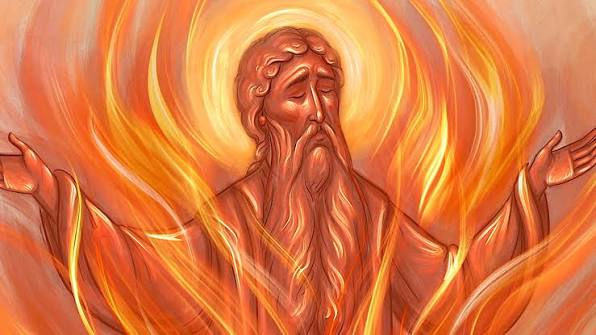
What the Church needs is not primarily better strategies, more refined programs, or stronger appeals to do more. She needs saints, men and women whose lives make visible what these words are trying to name. The Church is renewed not by explanation, but by incarnation. Fire must have a face.
A living icon of desire is someone who does not speak about prayer as an ideal, but whose entire manner of life is shaped by it. Their pace is slower. Their attention is gathered. Their words are fewer and more weighted. They approach the altar not as professionals or observers, but as those who know they are stepping onto holy ground. In their presence, one senses that something essential is at stake.
Such people do not persuade by argument. They attract by reality.
They do not exhort others to love the Eucharist. They reveal what it looks like when a human life is quietly organized around it. To be separated from the Liturgy wounds them. To prepare for it orders their days. To receive it rearranges their heart. Their prayer is not impressive, but necessary. Their silence is not empty, but inhabited.
This is how desire has always been transmitted in the Church. One learned how to pray by standing near someone who prayed. One learned how to approach the holy by watching how another approached it, with fear, joy, restraint, and longing. Formation was never primarily conceptual. It was relational. Desire was caught, not taught.
Where such living icons are absent, the Church grows accustomed to lukewarmness. Prayer becomes technique. Liturgy becomes routine. Reverence becomes performative. And the faithful, sensing the gap between words and life, quietly lower their expectations. They learn to survive spiritually rather than to burn.
But where even one heart is set on fire, the surrounding air changes.
A priest who lives from Liturgy to Liturgy catechizes more by his preparation than by his preaching. A monk or layperson who prays in secret and carries that prayer into patience, humility, and mercy becomes a silent proclamation. These lives remind the Church of what she already knows but has forgotten: that the Spirit must be begged for, that desire is a gift, and that the Eucharist is worth organizing one’s entire existence around.
The renewal of the Church will not begin with exhortations that ask people to try harder. It will begin when hearts dare to ask for a burning desire for the Lord and consent to let that desire simplify, purify, and reorder their lives. From such hearts, the Liturgy will once again be revealed for what it is: not an obligation to be fulfilled, but the place where a human life finds its meaning, its healing, and its rest in Christ.
Only saints can do this.
And the Church, in every age, is sustained by them.


Comments